
Japanese companies are giving Düsseldorf a larger role in their European operations, expanding from market entry into production, research and strategic management. The city’s engagement with Japan now spans security, green technology, health care, startups and academic exchange. In this interview, Annette Klerks, Head of the International Business Service at Düsseldorf’s Office of Economic Development; Benjamin Leonhardt, Senior Project Manager Japan at the Office of Economic Development; and Juliane Trautwein, Senior Project Manager Japan at the Office of Economic Development, discuss the investments, innovation programs and partnerships shaping Düsseldorf’s relationship with Japan in 2026.
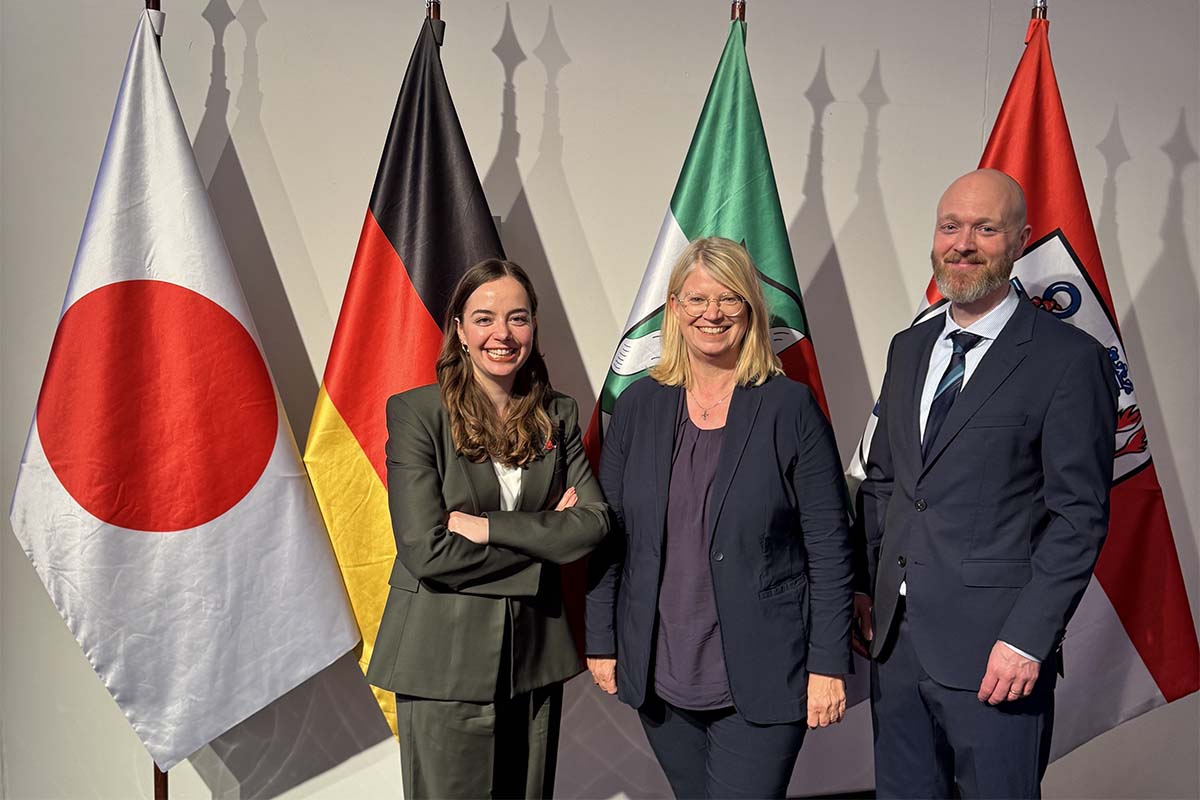
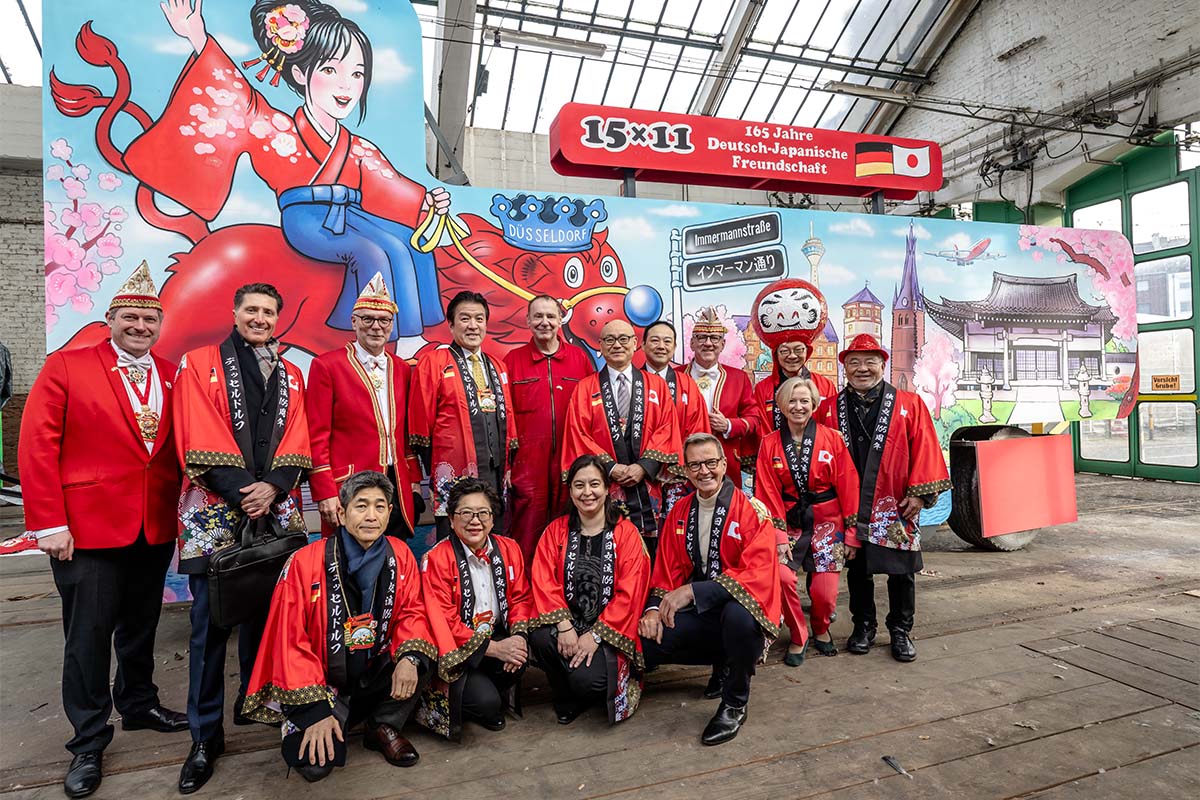
Bridges: Düsseldorf hosted its largest-ever Japan Day in May 2026, drawing around 700,000 visitors, and earlier in the year welcomed approximately 200 representatives of the Japanese economy at its cherry blossom reception focused on security, defence, renewable energy, AI and quantum computing. What does this scale and breadth of engagement tell you about how the relationship with Japan is evolving in 2026, and what stood out most from these events?
Leonhardt: Germany and Japan are working together in areas of strategic importance, and this partnership is becoming increasingly important in the face of growing global challenges. As a leading innovation hub and home to the largest Japanese business community in the EU, Düsseldorf is at the heart of this development.
In the first half of the year, Düsseldorf reinforced its role as a platform for dialogue for the Japanese business community, with discussions focusing on dual-use technologies, defence, and cybersecurity. In March, the Embassy of Japan in Germany hosted the seminar “Shaping Resilience: Japan-Germany Industrial Cooperation in an Era of Geopolitical Uncertainty” in the state capital. In the same month, the Japan Desk of the City of Düsseldorf, together with JETRO Düsseldorf and Messe Düsseldorf, organized a tour for Japanese companies at XPONENTIAL Europe—the leading European platform for autonomous systems, robotics, and uncrewed technologies. The strong interest from Japanese participants demonstrated the growing importance of these fields. The Japanese-German Business Association (DJW) also chose Düsseldorf as the location for its symposium focusing on security cooperation between Germany and Japan.
While security and resilience are increasingly important topics, cooperation in green technologies and sustainability remains equally relevant. These themes took center stage at Japan Business Day, one of the largest German–Japanese business events, held in Düsseldorf in May.
Not only Japan Day, but also DoKomi, one of Europe’s largest anime and Japan expos, broke records again this year. The event attracted around 230,000 visitors and has grown into Düsseldorf’s second-largest trade fair, further highlighting the strong presence and appeal of Japanese culture and business in the city. Beyond the participation of large corporations, the event also provided a platform for startups such as Capsule from Fukuoka.
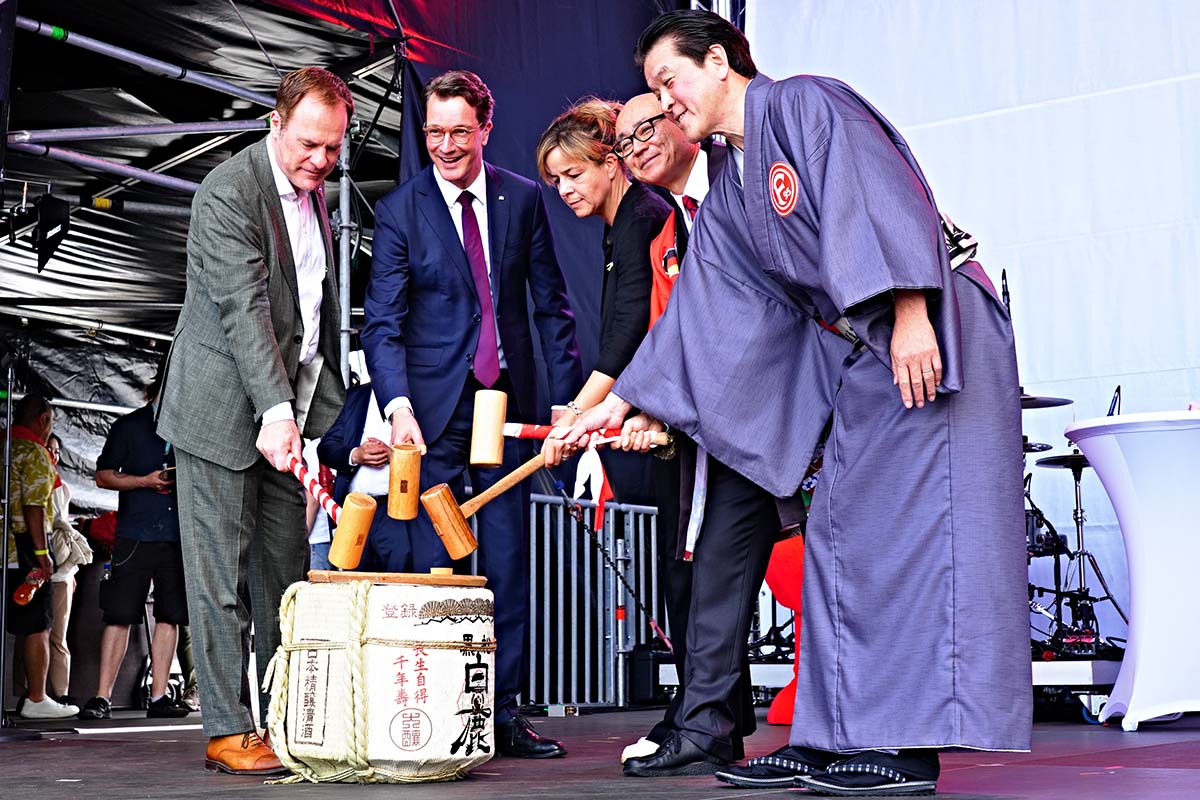
In 2025, 24 Japanese companies established new operations in North Rhine-Westphalia, with 22 choosing Düsseldorf specifically, alongside four corporate headquarters relocating to the city from elsewhere in the state. With examples such as Micware establishing its European headquarters here and Komatsu planning its new “Plant 2030” production hall in Benrath, what is drawing this latest generation of Japanese investment to Düsseldorf, and how does it differ from previous waves?
Trautwein: The positive trend is not limited to new investments—we are also seeing continued expansion by Japanese companies that have been established in Düsseldorf for many years. Besides Komatsu’s planned investment in new production facilities, another excellent example is Nishiyama Seimen, a ramen manufacturer from Sapporo. The company has chosen Düsseldorf as the location for its first production site outside Japan. This demonstrates the confidence that Japanese companies have in Düsseldorf as a long-term business location. Throughout both projects, the City Administration coordinates cross-departmental support, providing a unique service that strengthens companies’ confidence in the local authorities and helps ensure the successful implementation of major investments.
Düsseldorf continues to attract major research and innovation activities by Japanese technology companies. In 2024, Fujitsu opened its first Open All-Photonics Network Lab outside Japan in Düsseldorf. In 2025, Toshiba Electronics Europe GmbH further expanded the city’s innovation landscape by opening an HDD Innovation Lab dedicated to developing next-generation storage solutions.
“The 165th anniversary of German-Japanese relations highlights the depth and resilience of the partnership between the two countries.”
Japan Desk member Juliane Trautwein

Klerks: These investments reflect the diversity of Düsseldorf’s economy. Japanese companies from a wide range of industries—from manufacturing and automotive to food production and digital technologies— continue to invest in the city. This broad industrial base makes Düsseldorf particularly resilient and enhances its attractiveness even in times of economic uncertainty.
At the same time, Düsseldorf has increasingly established itself as the European consolidation hub for Japanese companies. Many businesses are centralizing their European operations here, expanding the role of their Düsseldorf offices to include strategic management, R&D, and innovation activities. This underlines that companies don’t see Düsseldorf simply as a gateway to Europe, but as a strategic base for sustainable growth.
This year’s Japan Business Day focused on the circular economy, featuring companies including Mitsubishi Electric, Toshiba Electronics Europe and LyondellBasell. Beyond the circular economy, Düsseldorf has identified healthtech, AI, the green economy, mobility and advanced manufacturing as priority sectors, with Tokyo-based healthtech startup MedVigilance recently joining the Welcome Package programme. How is Düsseldorf positioning itself to attract Japanese companies and startups in these emerging sectors?
Klerks: Düsseldorf is one of Germany’s leading start-up hubs and ranks among the country’s fastest-growing locations for start-ups and innovation.
Since 2020, Düsseldorf has been a partner in JETRO’s Global Acceleration Hub Program, with the Digital Innovation Hub Düsseldorf/Rhineland serving as the local partner. The program provides Japanese start-ups with excellent conditions for entering the German and European markets.
The Office of Economic Development offers tailored support programs for Japanese start-ups in innovative industries. The medX@Duesseldorf competition offers startups in the field of digital health and medtech the unique opportunity to exhibit at MEDICA’s Start-up Park while benefiting from exclusive networking opportunities with investors and industry leaders. In addition, the Welcome Package serves as a soft-landing program for international start-ups across a wide range of industries.
Every year, Startup Week Düsseldorf brings together more than 100 events dedicated to entrepreneurship, innovation, and the regional start-up ecosystem. Its flagship event, the Future Tech Fest—Germany’s largest B2B start-up expo and conference—is becoming increasingly international. The Japan Pavilion, organized by JETRO Düsseldorf, has become a well-established feature of the event. This year, delegations from Korea, the United States, India, and across Europe are also expected.
One of the latest initiatives is the DefenseTech Incubator.NRW, which strengthens security-related innovation through targeted incubation, networking, and support for start-ups, scale-ups, research institutions, established companies, and public-sector partners. The City of Düsseldorf has supported the project from its inception and played an active role in its development.
With around 400 Japanese companies already based in Düsseldorf and 2026 marking the 165th anniversary of German-Japanese diplomatic relations, what can we expect from the City’s engagement with Japan in the final months of the year, and how does Düsseldorf see its role evolving as this milestone year draws to a close?
Leonhardt: We are currently planning a delegation trip to Japan to further strengthen exchanges between the start-up ecosystems of Japan and Düsseldorf. The Japan Desk of the City of Düsseldorf, together with the TechHub.K67—a community and innovation hub for B2B tech start-ups in Düsseldorf that is home to around 100 companies—will participate in RamenTech in Fukuoka and the Global Startup EXPO in Osaka this October. In addition, we are planning activities in Chiba, Düsseldorf’s partner prefecture, as well as in Sendai and Tokyo.
MEDICA and COMPAMED in November will once again be an important highlight for our Japanese partners. Traditionally, the trade fair attracts numerous Japanese delegations, including participants from Fukushima, Chiba, Tokyo, Nagano, and other regions, providing a valuable platform for exchange in the fields of healthcare, life sciences, and medical innovation.
Trautwein: Towards the end of the year, we are also planning a smaller networking event at Düsseldorf University of Applied Sciences. Earlier this year, the university launched the HSD Japan Gateway Program, a project funded by the German Academic Exchange Service (DAAD) to expand and deepen cooperation with Japanese partner institutions. The program focuses on developing interdisciplinary teaching and research projects in the field of digitalization, particularly in the areas of Mixed Media and Human Data Interaction.
The 165th anniversary of German-Japanese relations highlights the depth and resilience of the partnership between the two countries. Düsseldorf has played a particularly important role in fostering these ties and will continue to do so. With its strong Japanese community and extensive network in Japan, the city will remain a leading platform for economic, technological, academic, and cultural exchange between Germany and Japan.