
Japan’s jazz kissaten were built for people who believed that listening was a sacred act. Tonyboy de Leon believed the same thing. A bar started it all. The audience wanted more.
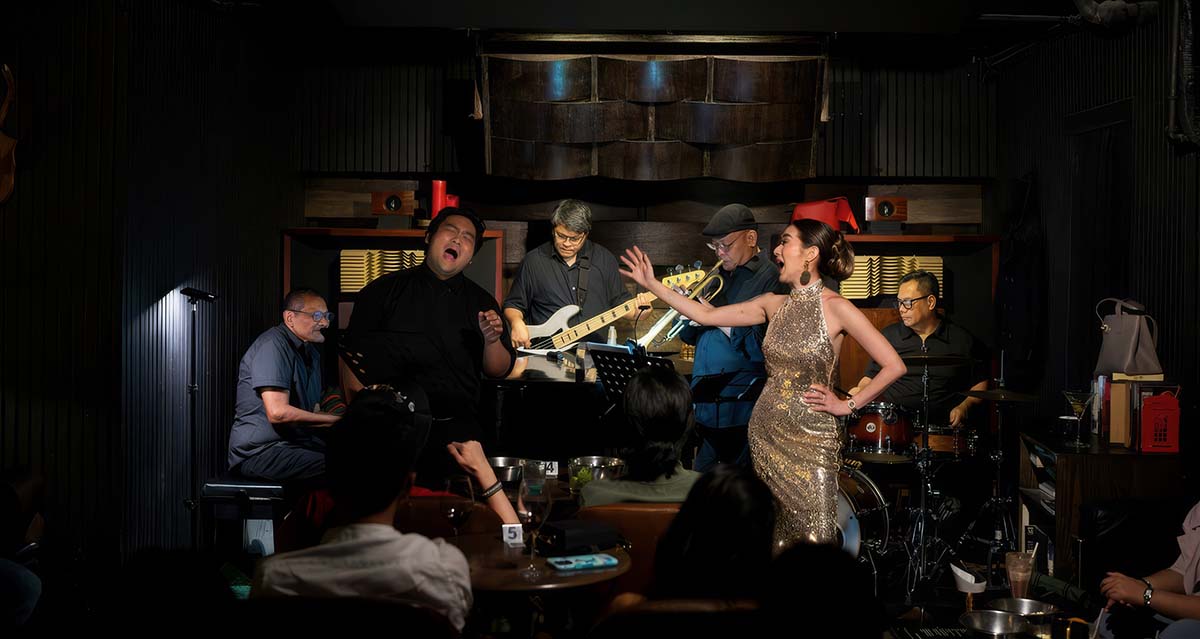
There is a rule at Eagle, a jazz kissa tucked into a narrow building in Yotsuya, Tokyo, that has been in effect since the establishment opened in 1967: no talking until six in the evening. Not a suggestion. A rule. The owner, Masahiro Goto, enforces it with the quiet authority of a man who has spent nearly six decades curating the exact conditions under which music should be heard. When the needle drops, you listen. The drink in your hand is incidental.

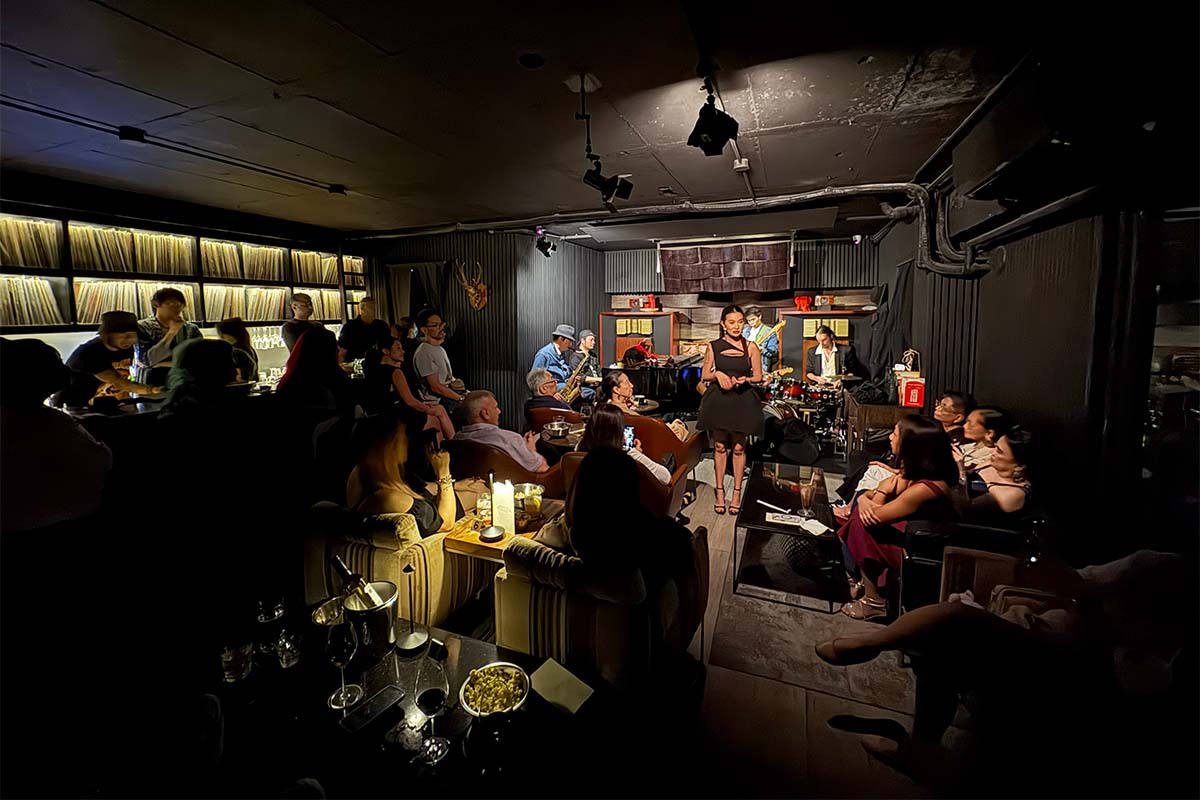
Tonyboy de Leon has the same rule. He just delivers it differently. Before a performance at 78-45-33, his bar on San Agustin Street in Makati, he steps in front of the crowd and tells them — in terms that would make a nun blush, he cheerfully admits — to shut up. The instruction lands the same way. The room listens.
De Leon arrived at this conviction the way all true believers do: by walking into a room in Shibuya in 2016, sitting down in front of a pair of vintage Western Electric speakers, and hearing something he had never quite heard before. “No one was talking,” he recalls. “People were really listening to the record. People in Tokyo are very considerate to others who were there just to listen.” He pauses. The word he reaches for is not “respectful” or “attentive.” It is simpler than that. “Respect,” he says. “That’s what was missing in Manila.”
The Listening Room
The kissaten — literally, tea-drinking shop — is older than Starbucks by a century and more serious than a café. By the Showa era, the long decades between 1926 and 1989, it had become one of the defining institutions of Japanese urban life. At their peak there were more than 150,000 across the country — salarymen holding meetings away from office hierarchies, university students escaping cramped dormitories, writers occupying corner tables for whole afternoons. A rarefied subset went further: they built temples to sound.
These were the ongaku kissa — music cafés — and their jazz variant became something close to a cultural phenomenon. In postwar Japan, imported records from America were prohibitively expensive. Home audio equipment capable of doing justice to a Miles Davis recording was beyond reach for almost everyone. A kissaten owner could absorb those costs, assemble a serious sound system, and offer the experience to anyone who could afford a cup of coffee. Musicians came to study records they couldn’t own. Students came for the bohemian atmosphere and stayed for Coltrane.
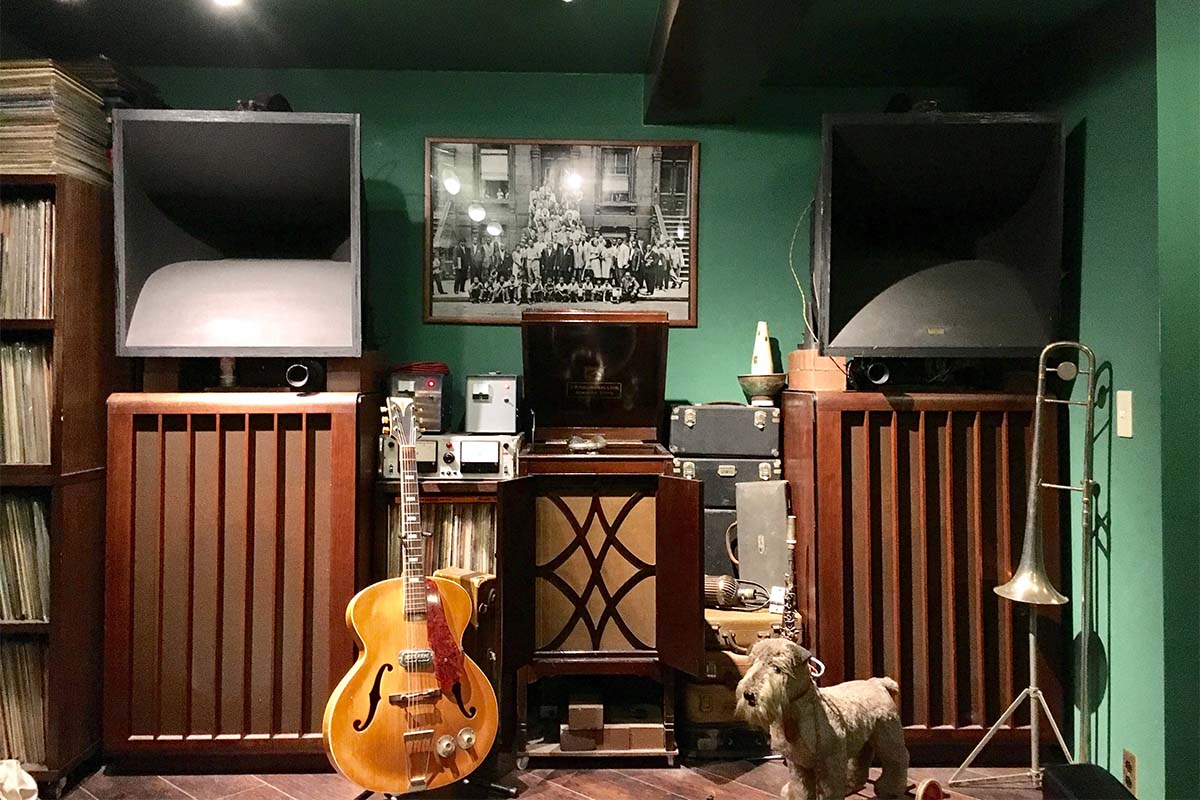
At the center of every jazz kissa is the mastū — the master — always the undisputed authority on what plays and when. The sound systems these masters assembled remain extraordinary: vintage JBL or Altec horn speakers sometimes taller than a person, tube amplifiers emitting their warm amber hum, turntables calibrated for rooms designed specifically around them. Volume is set high — not aggressively, but revelatorily. The point is to hear everything: the space between notes, the breath before a phrase, the particular quality of a recording made in a New York studio in 1959.
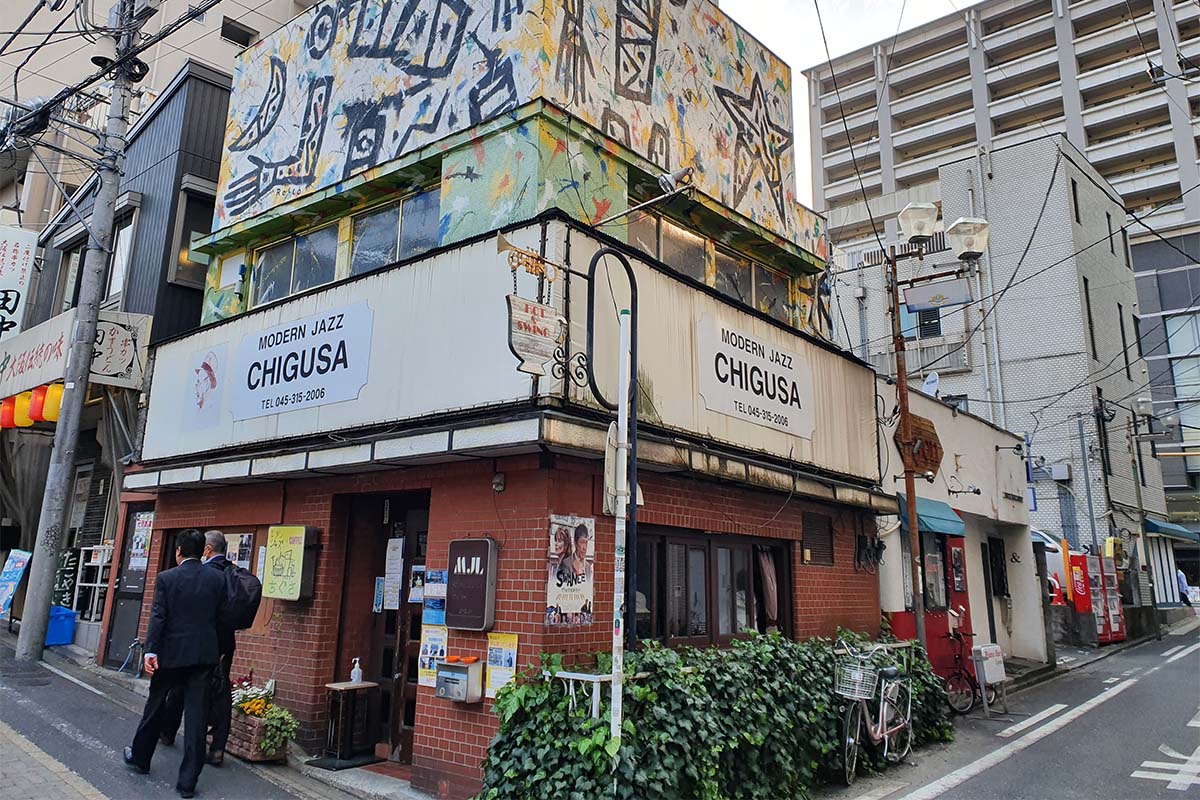
Some of the most legendary kissaten carry histories that feel almost novelistic. Chigusa in Yokohama has been open since 1933, the oldest jazz kissa still operating in Japan. Eagle in Yotsuya has enforced its silence rule since 1967. Masako in Shimokitazawa once hosted Charles Mingus and Mal Waldron during their tours of Japan. De Leon’s own revelation came at Swing Shibuya, whose restoration of vintage Western Electric gear has made it a pilgrimage site for audiophiles worldwide. “The vintage Western Electric gear and the sound quality was a revelation,” he says. He went back. He took notes.
What the Numbers Mean
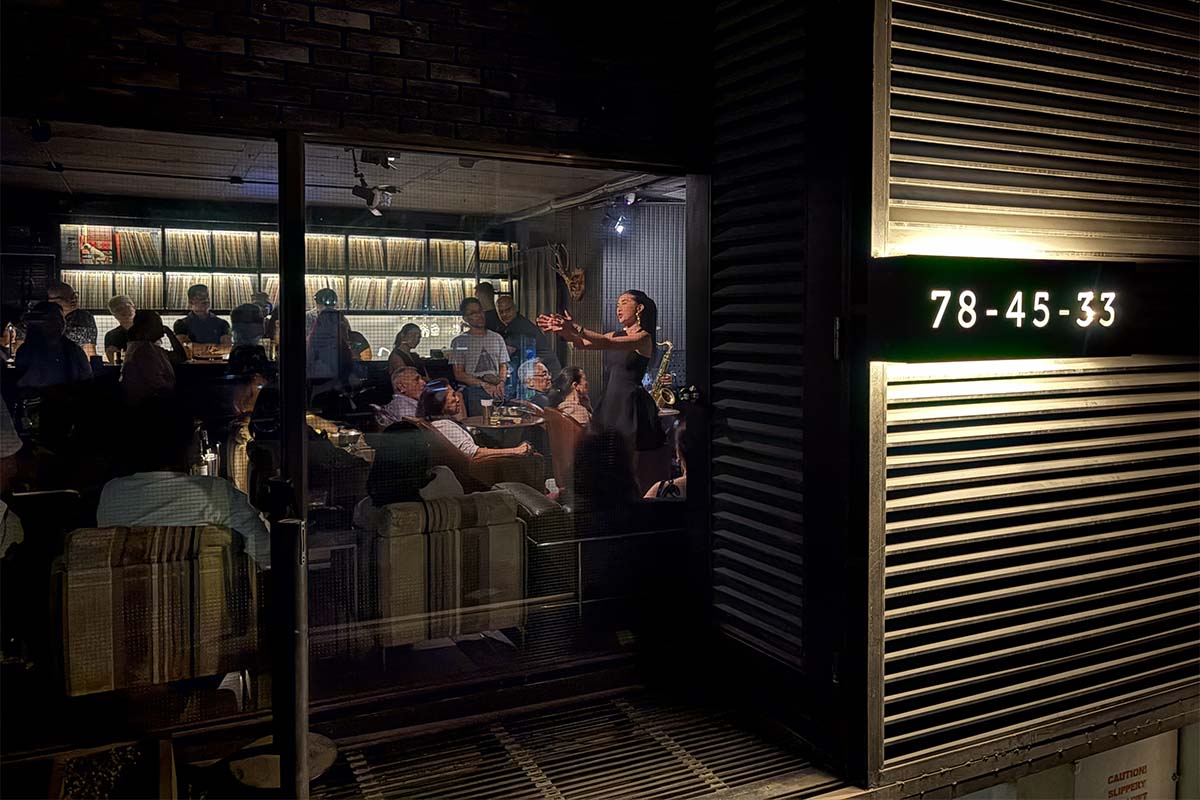
The building at 107 L.P. Leviste Street in Makati was developed by the Leviste family. Tonyboy de Leon is one of them. The bar’s entrance is on San Agustin Street at the back — you have to know it’s there, which is as it should be. Great kissaten have never announced themselves loudly. The best rooms ask a little something of you before you enter.
He called the bar 78-45-33.
For anyone who has owned a turntable, the name requires no explanation: those are the three speeds at which vinyl plays. Seventy-eight RPM for the shellac 78s of the early twentieth century, the format on which jazz was first pressed and distributed. Forty-five for the seven-inch single. Thirty-three and a third for the long-playing album — the LP — the format around which the jazz kissaten built their entire philosophy.
He did not notice, when he named the bar, that L.P. Leviste Street shared its initials with the format he loves most. It was an accident.
A man so thoroughly absorbed in his world that the coincidence assembled itself around him without his noticing.
The Sound of the Room
De Leon is the founder of The November Hi-Fi Show, the annual gathering that has become the definitive event for audiophiles in the Philippines. 78-45-33 grew directly from that world.
The system he assembled for the bar is the point. At its heart are a pair of restored 1957 JBL Hartsfield speakers, a corner horn design that JBL originally produced for home listening rooms and concert halls, driven by a Naim integrated amplifier and a Wiim Ultra streamer. The bar also houses a Steinway baby grand, a DW drum kit, a Fender Blues Junior guitar amplifier, and a custom-built bass guitar amplifier designed by Joey Abad Santos, who also designed Upstairs, the performance space above the bar.
Tonyboy de Leon is the founder of The November Hi-Fi Show, the annual gathering that has become the definitive event for audiophiles in the Philippines. 78-45-33 grew directly from that world.
Performing without a microphone is hard. “There are no electronics to help them project their voice,” de Leon says. What the room demands, it also rewards. When Japanese jazz pianist Makoto Kuriya arrived to perform, he brought a portable electric piano as insurance — unconvinced that a Steinway in a Makati bar would be in sufficient condition. He plugged in the electric piano, played some test passages, then crossed the room and tried the Steinway. He sent his assistant to take the electric piano back to the car. That night, Kuriya played so freely he broke two strings. “The performance,” de Leon says, “was worth it.”
The Collection
Every serious jazz kissa has its record collection, and every collection has its stories. At 78-45-33, the most valuable by market measure is a copy of Seona Dancing’s More to Lose — a single so obscure its value derives less from the music than from what it represents to collectors. De Leon has seen offers of twenty-five thousand pesos for it. “That’s way too much,” he says.
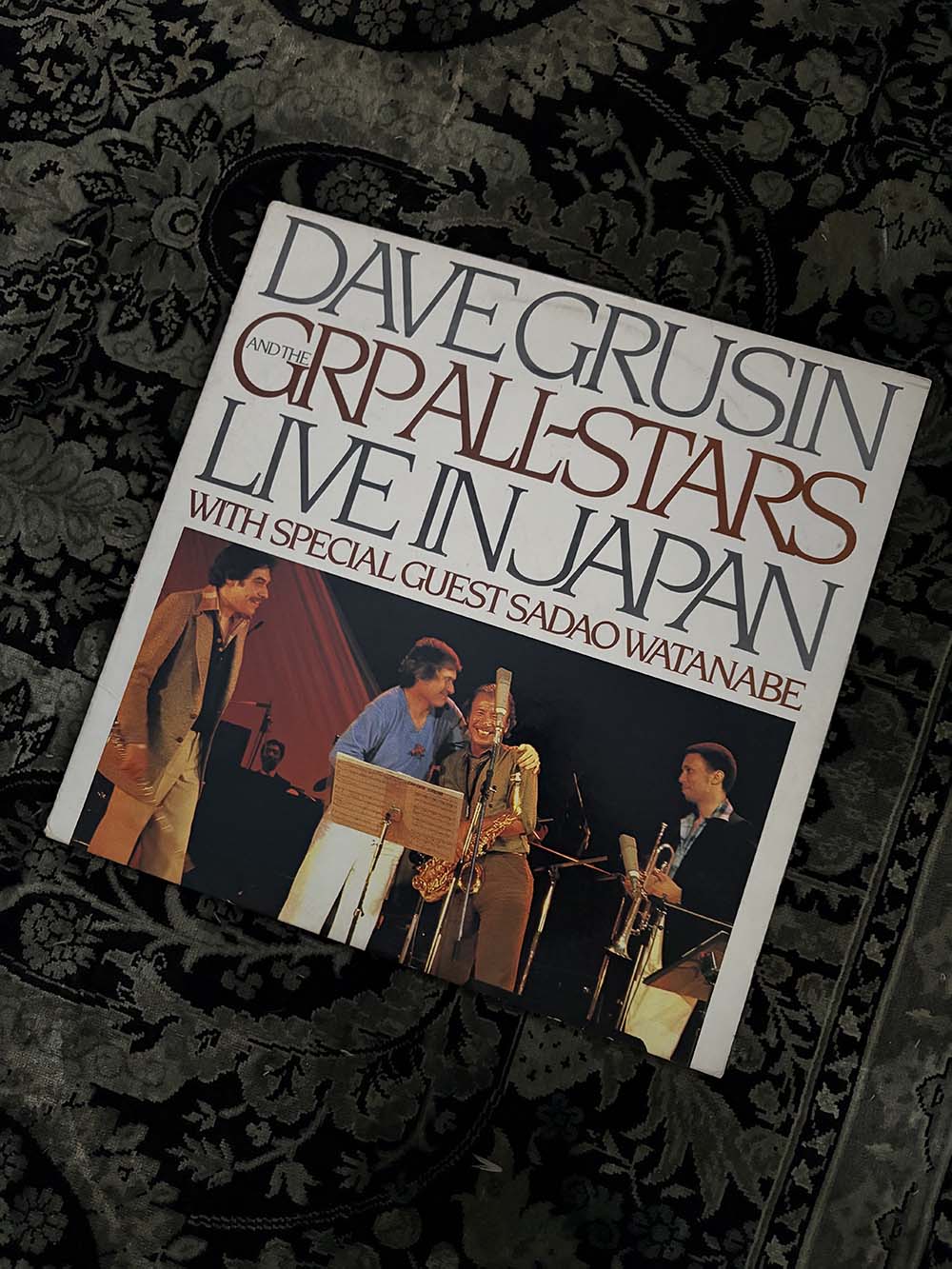
More meaningful to him is a copy of Dave Grusin’s GRP All-Stars Live in Japan — never released in digital form, which means the only way to hear it now is on vinyl. He found an unopened copy in Bangkal in the early 2000s and he credits it with reigniting the collecting passion that has defined the decades since.
He has never opened that copy.
“I didn’t have the heart to open it,” he says. He later found three used copies, which he plays regularly. The sealed original stays sealed. Some things are worth more intact.
Upstairs
Above the bar, de Leon is completing something even more deliberate. Upstairs is a dedicated performance space built from the floor up, its acoustic references Carnegie Hall and La Scala. The room itself is shaped like a horn speaker, designed to amplify and project the sound of performers without a public address system. It will seat around forty people, fifty standing — built for jazz, blues, rock, Broadway, and, de Leon adds with the equanimity of a man who has made peace with the full range of human musical expression, raves.
On Listening
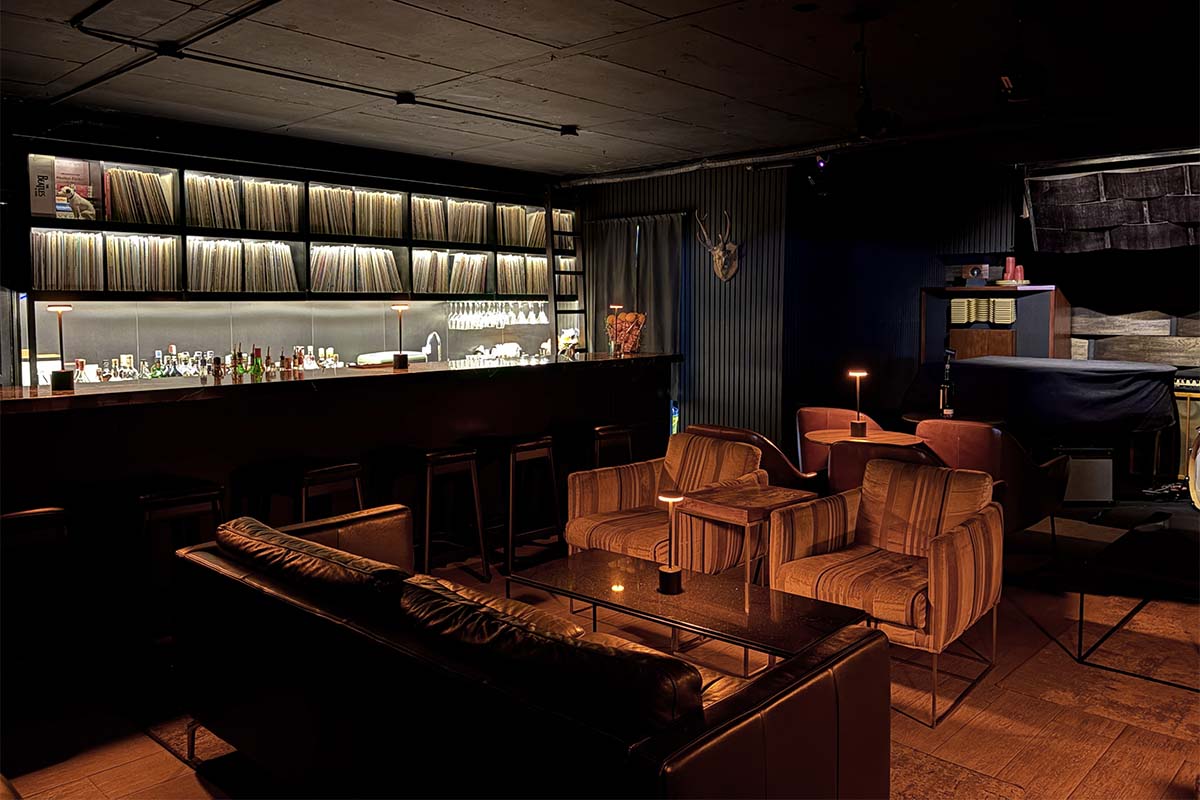
Japan’s jazz kissaten went into decline from the 1970s onward as home audio became affordable and the communal listening room lost its practical justification. At their peak there had been 600. Now the survivors are ageing — owners in their seventies and eighties without successors, rooms that will close when the master does. Yet the jazz kissa has become an object of international pilgrimage precisely because of what streaming erased: the physical act of selecting a record, the ritualised preparation of a listening space, the shared silence of a room full of people giving music their complete attention.
This is the world de Leon understood before the trend caught up with him.
He steps in front of the crowd at 78-45-33 and tells them, in his own fashion, to be quiet. In Yotsuya, Masahiro Goto raises a finger. Sixty years apart and a thousand miles, the instruction is identical. The needle finds the groove. The room waits to hear what it was built to hear.
78-45-33 is located on San Agustin Street, Makati City, in the building at 107 L.P. Leviste Street. The November Hi-Fi Show, founded by Tonyboy de Leon, is held annually.