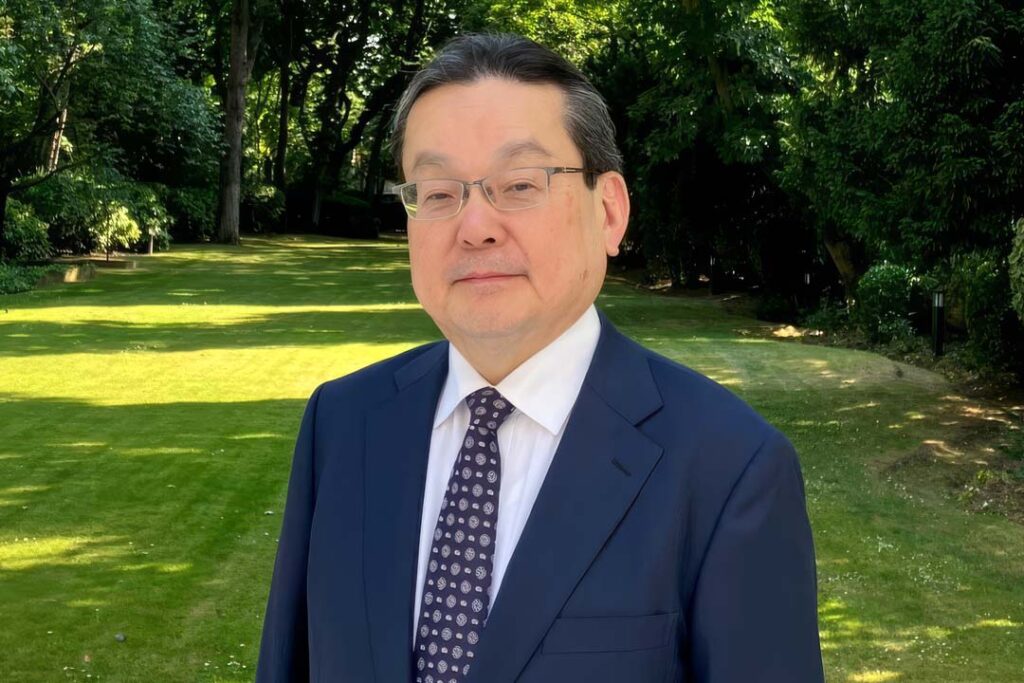

Lechevalier is the founder and the president of the Fondation France-Japon de l’EHESS (FFJ).
He is also researcher at the Maison Franco-Japonaise and recently joined the Canon Institute for Global Studies (CIGS) as an International Senior Fellow.

How would you characterize the current economic relationship between France and Japan?
Japan and France have enjoyed a strong economic relationship for several decades. The relationship is characterized by a significant level of trade. According to the French Treasury, there were 5.6 billion euros of exports from France to Japan and 8.4 billion euros of exports from Japan to France in 2020.
This means the trade relationship between the two countries is characterized by a trade deficit of approximately 2.8 billion euros on the French side. The development of foreign direct investments (FDI) between the two countries is of paramount importance and has been for several years.
France is now ranking second in the world in terms of the origin of foreign investment to Japan; both in stocks (32 billion euro, which is more than eleven percent of total foreign investments) and flows (2.6 billion euro in 2019), behind the United States of America and ahead of the United Kingdom.
In 2019, Japanese companies invested 1.5 billion euros in France. The stock is 15.6 billion euros, which corresponds to less than one percent of the total Japanese FDI. France globally ranks number twenty in terms of Japanese FDI, while, from a French perspective, Japan is the tenth foreign investor in France and number one amongst Asian countries.
Around 510 Japanese companies are doing business in France, and created employment for nearly 98,000 people in 2019. Cooperation between the two countries is progressing in various fields including; automobile, aircraft, nuclear, digital, steel and food.
The classic examples are the Renault-Nissan alliance, automotive production by Toyota France and the purchase of Airbus aircrafts (by ANA and JAL). In addition, there have been investments by Mitsubishi Heavy Industries in Framatome and Fujitsu continues to invest in digital innovation projects and start-ups.
Cooperation between the two countries is progressing in various fields including; automobile, aircraft, nuclear, digital, steel and food.
What steps need to be taken to further strengthen the France-Japan partnership?
Despite the high-levels of economic relations, there is still room for improvement and strengthening of the France-Japan partnership — allow me to give two examples:
One concerns economic cooperation in third countries. This has been a long-term objective for the governments of the two countries, as they are characterized by a strong complementarity of their respective spheres of economic influence (basically Europe and West Africa for France and Asia, including Southeast Asia for Japan and similar targets in the Indo-Pacific Zone). However, much more can be done in this field, through a higher level of integration, trust and with a clearer roadmap.
The second is related to cooperation in innovation. In a report for the ‘nichi futsu club’ and Valeo, I showed, together with my colleague, Prof. Jun Suzuki, that in a context of high-level competition and increasing complexity of technologies, the gains from cooperation are even more important between Japan and France.
Both countries are characterized by complementarities in their innovation systems and we believe that research and development cooperation between the two countries could be further strengthened, both at the corporate level and at the level public research institutes.
In this last case, the Japan Science and Technology Agency (JST) and the French National Centre for Scientific Research (CNRS) on the other hand have already initiated collaboration through joint labs that could be extended and deepened.
Both countries are characterized by complementarities in their innovation systems and we believe that research and development cooperation between the two countries could be further strengthened, both at the corporate level and at the level public research institutes.
Sébastien Lechevalier, President of the Fondation France-Japon de l’EHESS (FFJ)
With both countries emerging from the pandemic, what have we learned about the bilateral relationship between the two countries?
To my surprise, despite the pandemic, the relationship between the two countries has been stable and relatively dynamic, despite various impediments.
Previous collaborations have been continued, thanks to the generalization of videoconferences and so on while new projects have stopped or at least faced severe difficulties.
It is now time to lift restrictions, especially regarding mobilities, in order to promote a vibrant rebound and engage ourselves in new projects, which correspond to the numerous issues we are facing; including climate change and ageing societies. In these fields, technologies cannot do everything and social innovation is the most important factor; this is why a deep and sustained dialogue is required.