
Formula 1 doesn’t just race through Japan—it transforms it. At Suzuka, speed meets culture, heritage, and record-breaking ambition, all on a single track.
Formula 1’s impact in Japan


Formula 1 doesn’t just pass through Japan—it collaborates with it.
In the build-up to Suzuka, F1 leaned into its role as a bridge between cultures—where drivers don’t just race, they immerse. Charles Leclerc traded the paddock for the refined stillness of Nagoya Castle’s ESPACIO hotel—an official Ferrari partner—where architecture, heritage, and luxury collide, distinctly Japanese yet unmistakably Ferrari.
Then there was Lewis Hamilton, stepping back into the dojo. His Instagram caption—“Back in the dojo 🇯🇵… unreal to have a lesson with @tetsuroshimaguchi”—was more than a post; it was a moment of respect. Training with Tetsuro Shimaguchi, a modern master of samurai performance, Hamilton blurred the line between athlete and student—proving F1 is as much about respect as it is about speed.
In the build-up to Suzuka, F1 leaned into its role as a bridge between cultures—where drivers don’t just race, they immerse.
Teams followed suit. TGR Haas F1 Team debuted a Godzilla-inspired livery, marking the start of a season-long collaboration with TOHO Co., Ltd.—the studio behind Japan’s most enduring cinematic icon. It wasn’t just branding; it was storytelling at 300 km/h.
Hollywood met Suzuka on Sunday. Cast members from The Super Mario Galaxy Movie were woven into the weekend’s adrenaline, with Jack Black waving the chequered flag—turning the race finish into a pop-cultural crossover moment. Funnily enough, drivers have been calling the 2026 season very “Mario Kart”-esque, making this feel less like a cameo and more like a full-circle crossover.
This is what Suzuka does best: it dissolves boundaries. Sport becomes culture. Culture becomes racing DNA.
Japan’s ever-evolving presence in F1


On both macro and micro levels, Japan is embedded in the DNA of modern Formula 1.
From title sponsorships to technical partnerships, its influence stretches across the grid. Haas F1 Team continues to deepen its relationship with Toyota Gazoo Racing, while its collaboration with TOHO Co., Ltd. signals a new kind of commercial creativity—where entertainment and engineering co-exist.
At Aston Martin F1 Team, the Honda power unit signals a cultural and technical reunion years in the making. Honda’s championship pedigree is undeniable, but in 2026, the performance is still catching up—leaving the partnership poised between legacy and potential.
Meanwhile, Williams Racing’s partnership with Komatsu reflects Japan’s industrial weight beyond automotive borders. Signed in 2024 as a multi-year principal partnership, a reminder that F1 isn’t just about laps—it’s a global game of strategy and influence.
Ferrari, too, leans into this connection through ESPACIO Nagoya Castle—where heritage becomes a branding platform, aligning Italian prestige with Japanese history.
And then there’s identity. Racing Bulls’ livery, designed by Aoyagi Bisen, transformed the car into a moving expression of shodō. In a sport obsessed with marginal gains, this was something different: meaning.
Japan’s presence in F1 doesn’t shout—it resonates everywhere.

The race
When the lights went out, Suzuka came alive: young stars chasing records, teams scraping for every advantage, and every lap underscoring just how much the sport has evolved. The new style of racing—heavily strategic, energy-conscious, and unpredictable—tests drivers and teams in ways fans haven’t always seen here. As Toto Wolff put it, it’s “a new way of racing where you have to think strategically… it makes the race very unpredictable.”
Oscar Piastri finally got his season underway after early-round setbacks—and delivered immediately. A composed drive brought him home in P2, a result that felt like a reset for the season ahead.
For Aston Martin F1 Team, finishing the race cleanly was a meaningful step. Fernando Alonso crossed the line in P18, and while it wasn’t a headline result, the team showed signs of momentum—proof that the partnership with Honda is gradually finding its rhythm.
At Ferrari, Charles Leclerc secured his second podium of the season with P3, continuing a quietly consistent run that’s keeping him within striking distance in the early championship picture.
But Suzuka belonged to one name.
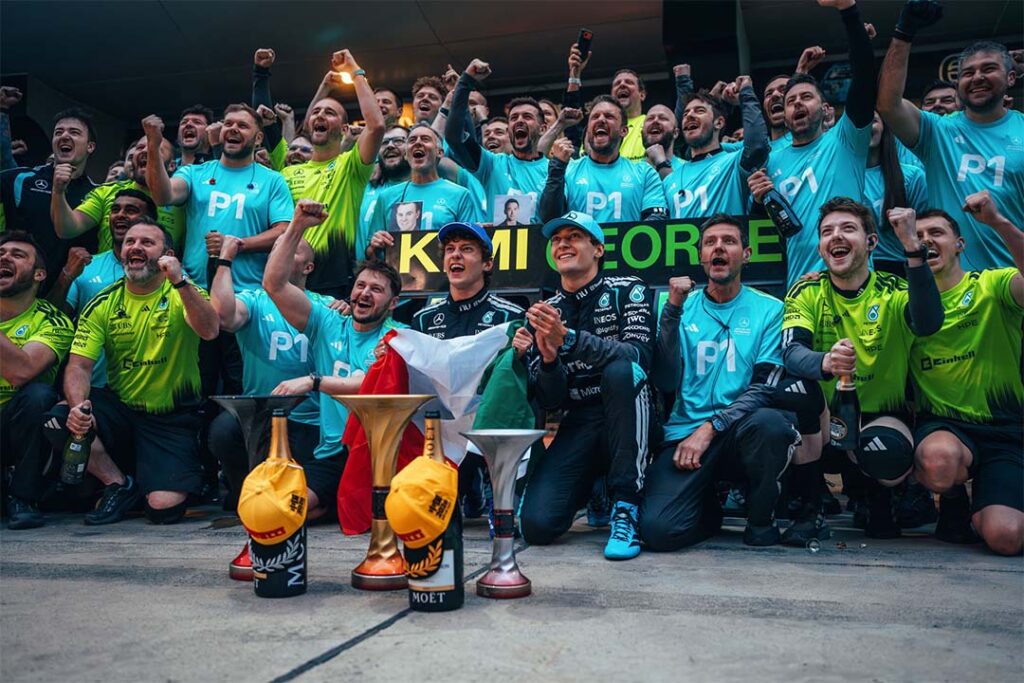
Kimi Antonelli.
Fresh off his maiden win in China, Antonelli returned and did it again—just 14 days later. Back-to-back victories. As a teenager. In Formula 1.
Kimi Antonelli, making F1 history

Antonelli’s weekend didn’t start on Sunday—it began on Saturday with pole position, a milestone that doubled as a national moment. He became the 50th Italian driver to secure Pole Position in Formula 1, a symbolic achievement for a country whose racing identity runs deep.
By Sunday afternoon, symbolism had turned into history. Kimi Antonelli became the youngest driver ever to lead the Formula 1 World Championship, the first teenager in history to win multiple Grands Prix, and joined a rare 21st-century club with Lewis Hamilton and Charles Leclerc, winning right after a maiden victory. He also marked more milestones for Italy, becoming the first Italian to lead the championship since Giancarlo Fisichella in 2005 and the first to win back-to-back races since Alberto Ascari in 1953. It was a weekend where youth, history, and national pride collided, and the records Antonelli set will echo long after the checkered flag.
As Antonelli himself put it, “I am going to enjoy the moment but use the time well to work on where I can improve… we know we need to keep raising our game too.”
This isn’t just a breakout—it’s a generational shift. Antonelli represents a new kind of F1 driver: digitally native, globally fluent, and unburdened by legacy even as he rewrites it.
Racing history, building bridges

What unfolded in Japan wasn’t just a race weekend—it was a reminder of what makes Formula 1 unique: a sport that moves at the intersection of history, culture, and raw human ambition.
Between Italy and Japan, through Ferrari and ESPACIO. Between Britain and Japanese tradition, through Hamilton in the dojo. Between Hollywood and motorsport, through Mario on the Suzuka grid. And between past and future, through Antonelli—a teenager carrying decades of history into something entirely new.
In F1, connection is as essential as speed, and Suzuka proved it. Culture, competition, and collaboration collide here in a way unlike anywhere else, turning milestones into moments that matter, and ambition into stories the world talks about.
At 300 km/h, Formula 1 doesn’t just race—it rewires what’s possible on and off the track.