

As global energy systems shift toward lower-carbon and more resilient supply chains, the Edmonton region is positioning itself at the center of Canada’s emerging hydrogen economy. With longstanding expertise in energy infrastructure, carbon capture, and industrial-scale operations, the region is increasingly being viewed as a credible long-term partner for Asian markets, particularly Japan, whose hydrogen strategy is closely tied to both decarbonization and energy security. In this Q&A with Bridges Magazine, Brent Lakeman discusses why Edmonton matters in Japan’s energy equation, how Canada can build trusted hydrogen partnerships with Asia, and what commercial success for the region’s hydrogen ecosystem could look like in the years ahead.
Bridges: Why Edmonton Matters in Japan’s Energy Equation Japan’s hydrogen strategy is driven not only by decarbonization goals, but by long-term energy security and industrial policy. In that context, what makes the Edmonton region particularly credible as a future hydrogen partner for Japan beyond production capacity?

Brent Lakeman: The Edmonton region matters in Japan’s energy equation because it is already proving what a reliable clean-energy system looks like in practice. Hydrogen isn’t theoretical in the Edmonton region. It is being actively built, deployed, and integrated into a functioning industrial ecosystem. Our hydrogen ecosystem shows how production, innovation, supportive policy, and industrial operations can work together in a stable, coordinated way.
The region is an international leader in clean energy, with the experience, infrastructure, and skilled workforce needed to produce low-cost, low-carbon hydrogen consistently and at global scale – and we’ve been doing it for decades. Our region’s access to low-cost feedstock such as natural gas, our history of commercial-scale carbon capture, utilization and storage technologies and supportive incentives and regulatory systems position us as a key provider of hydrogen to Asian markets.
Just as important, the Edmonton region serves as the central meeting point for Canada’s hydrogen value chain. It is where projects advance, partnerships form, and commercialization moves forward. That coordination reduces risk and supports long-term investments.
For Japan, this signals credibility, which is being demonstrated by some of the world’s largest hydrogen production companies which are currently constructing projects in the Edmonton region, the home to large industrial hydrogen users.
“The Edmonton region matters in Japan’s energy equation because it is already proving what a reliable clean-energy system looks like in practice.”
Brent Lakeman, Executive Director, Edmonton Region Hydrogen Hub
From your discussions with Japanese partners such as Kawasaki Heavy Industries, what must Canada demonstrate to move from potential supplier to trusted strategic partner?
From discussions with Japanese partners like Kawasaki Heavy Industries, the message is consistent: Canada has to show that it can build on its advantages to deliver hydrogen at scale, consistently, and over decades. That means suppliers must demonstrate industrial-grade operations, bankable projects, and the ability to expand volumes without disrupting reliability. That includes demonstrating expertise in the whole energy system including transport, storage, logistics, and integration into global supply chains.
Canada must also be able to show that hydrogen projects are backed by coherent, durable policy frameworks — across federal, provincial, and local levels — and that those frameworks will hold as projects mature.
Canada also has a supportive innovation ecosystem that can partner with Japanese organizations to advance critical technologies and infrastructure that connects hydrogen production in Canada to global markets. Supports from organizations like Emissions Reduction Alberta (ERA) and Alberta Innovates can help create a foundation for subsequent investments from partners in Canada and Japan.
Edmonton’s energy relationship with Japan builds on familiar ground. Japan has long sourced energy from jurisdictions with deep experience in large-scale resource development, trade, and infrastructure finance. What matters now is showing that this experience can be translated into a low-carbon supply chain without losing the qualities Japan values most — reliability, transparency, and long-term thinking.
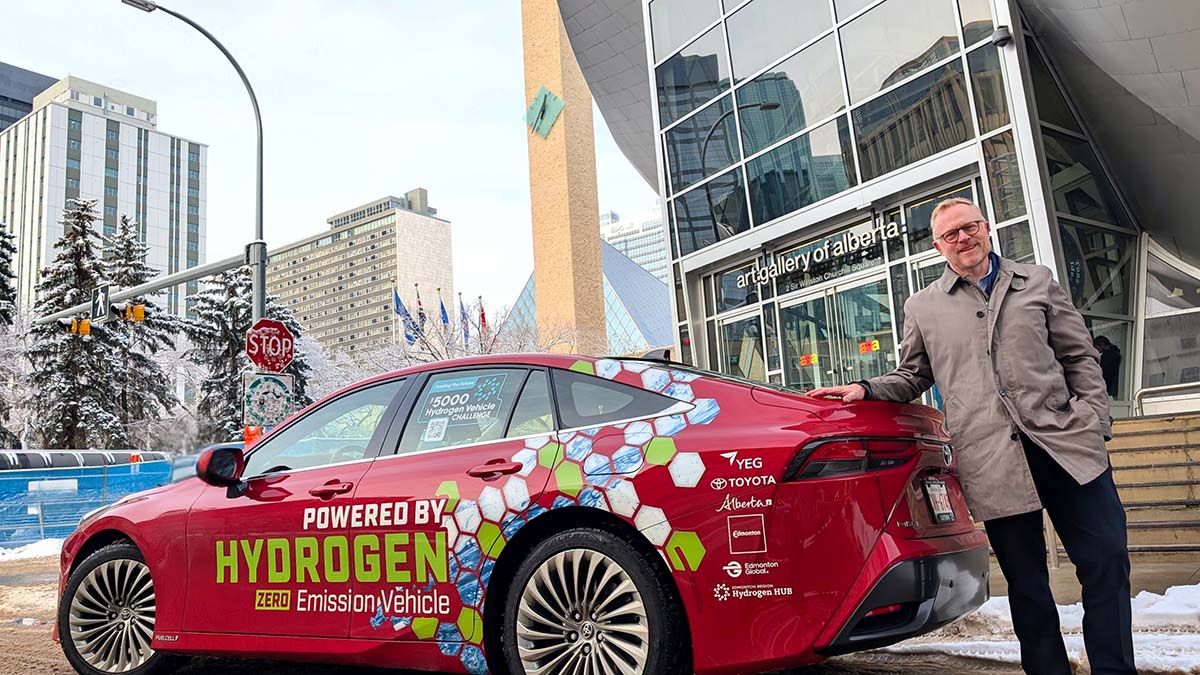
How do you see Edmonton helping demonstrate that hydrogen can become commercially durable rather than remain a promising but narrow energy pathway?
There is no “silver bullet” alternative energy source to decarbonization, but hydrogen is a viable solution for many hard-to-abate sectors — and that’s where the Edmonton region plays an important role.
The region is focused on applications where hydrogen actually makes sense: heavy industry, freight and logistics, chemicals manufacturing, and long-haul transportation. These are sectors where hydrogen can support both emissions reductions and operational reliability while scaling our capabilities.
A key part of this is building demand alongside supply. For example, the Edmonton Region Hydrogen Hub is advancing the Western Canada Hydrogen Corridors Initiative, a roadmap to help Western Canada’s commercial transportation sector clarify the conditions needed to scale demand, unlock infrastructure investment, and reduce costs over time — ensuring there are vehicles on the road, refueling infrastructure in place, and customers ready to use the fuel.
Large anchor projects also matter. The region is already home to the majority of Canada’s hydrogen production and companies like Air Products and Linde are building new projects that will further position the region as a long-term supplier of low carbon hydrogen to end users.
The successes of many projects in the region are supported by Edmonton’s innovation ecosystem. The region has deep research and development capacity, combined with industrial partners who can take technologies out of the lab and into real operations. Local partners like C-FER Technologies and the University of Alberta Centre for Hydrogen Innovation, Workforce Development and Outreach are instrumental in supporting commercialization.
Taken together, Edmonton’s approach shows that hydrogen becomes commercially durable not through hype, but through focus: applying it where it works best, building markets alongside infrastructure, and grounding innovation in real industrial use. That’s how hydrogen shifts from being promising to being dependable.
“There is no ‘silver bullet’ alternative energy source to decarbonization, but hydrogen is a viable solution for many hard-to-abate sectors — and that’s where the Edmonton region plays an important role.”
What would meaningful success look like for Edmonton’s hydrogen hub over the next five years, particularly in relation to Japan and wider Asian demand?
Looking ahead, success for the Edmonton Region Hydrogen Hub would be measured by whether partnerships translate into real, functioning supply chains that serve Asian demand.
That means moving from feasibility studies to tangible progress: hydrogen being produced at scale, transported reliably, and integrated into export pathways that Asian buyers can plan around with confidence.
It also means deepening relationships, not just expanding trade. Success would include Japanese and Asian firms becoming more embedded in the Edmonton region’s ecosystem — collaborating on technology, logistics, and standards, and helping shape how supply chains evolve over time.
Commercial durability will be another key marker. If hydrogen projects in the region are supported by anchor demand, efficient logistics, and long-term policy alignment, that sends a strong signal to Asian markets that this is not a speculative pathway, but a stable energy option worth committing to.
Finally, success is about positioning Edmonton as a long-term partner to Japan. Five years from now, Japan and other Asian markets should see the region as a dependable supplier of hydrogen as part of their energy mix. This MOU is the starting point that will enable ongoing, reliable partnerships that support economic growth and prosperity across jurisdictions.
As Japan accelerates efforts to diversify and decarbonize its energy imports, partnerships with regions capable of delivering reliable, scalable hydrogen solutions will become increasingly important. For Edmonton, the opportunity extends beyond exports alone. The region is seeking to establish itself as a long-term strategic partner, one that combines industrial capability, policy coordination, innovation, and commercial practicality. As Brent Lakeman suggests, the next phase for hydrogen will not be defined by ambition alone, but by the ability to build dependable supply chains and enduring international partnerships grounded in real-world delivery.