

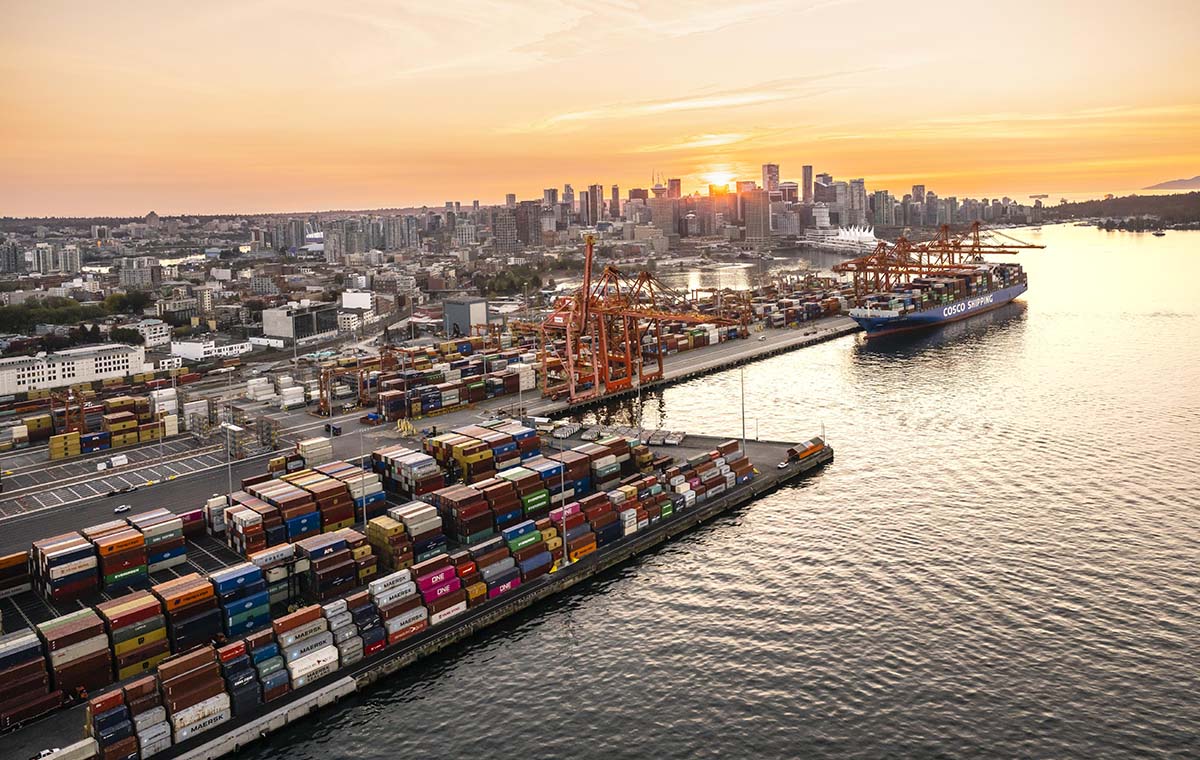
The Port of Vancouver is Canada’s largest port and North America’s most diversified, spanning 29 major terminals and more than 1,000 tenants. It moves more cargo annually than Canada’s next five biggest ports combined, handling everything from bulk grain and coal to containers, vehicles and project cargo. Few overseas relationships run as deep as the one with Japan.

Japan has long stood as one of the port’s most vital trading partners, and today it remains a cornerstone of Canada’s Indo-Pacific strategy. In 2025, the countries moved 13.6 million metric tons of two-way trade through this gateway, making the country Canada’s second-largest trading partner.
“Canada and Japan have a long, robust shared history,” said Peter Xotta, president and CEO of the Port of Vancouver. “We know we have a role in connecting Canada and Japan as the two countries — and likeminded allies — look to forge a stronger trading relationship based on trust, stability and respect.”
That trade is headlined by bulk exports of Canadian commodities such as steelmaking coal, copper concentrate, wheat, canola and forestry products, alongside smaller but high-value flows in both directions, with Japanese vehicles and parts arriving in Canada, and critical minerals like nickel heading to Japan.
Xotta pointed to the Comprehensive and Progressive Agreement for Trans- Pacific Partnership and recent federal trade missions as signs of growing appetite on both sides. “The Port of Vancouver has the infrastructure and capacity needed to support this growth in goods movement,” he said.
“Canada and Japan have a long, robust shared history. We know we have a role in connecting Canada and Japan as the two countries — and likeminded allies — look to forge a stronger trading relationship based on trust, stability and respect.”
Peter Xotta, President and CEO of the Port of Vancouver

In 2025, the port handled 170 million metric tons of goods worth $365 billion (¥58 trillion). Its proximity to Japan and inland rail connections support Ottawa’s push to double exports to non-U.S. markets, including through the new Canada Critical Minerals Accelerator. Projects underway include rail upgrades serving copper, grain, potash and coal exporters, plus improvements at the Westshore terminal to move more potash. Japan alone imports roughly 200,000 tons of Canadian potash and up to 350,000 tons of copper concentrate annually. Roberts Bank Terminal 2, an upcoming container terminal, is expected to unlock $100 billion in annual trade capacity.
Sustainability is shaping the relationship, too. Electric tugs now help move coal exports bound for Japan, and Vancouver port has signed a memorandum of understanding with its sister port in Yokohama to share environmental programs.
“As Canada’s port, we’re here to help get more of what Canadians make, mine, harvest and grow to more overseas customers like Japan,” Xotta said.