
Japan Gold Corp. has spent more than a decade exploring for gold in Japan, building a portfolio across Hokkaido, Honshu and Kyushu. Founded in Vancouver and listed on the Toronto Stock Exchange’s TSX Venture Exchange, the company holds more than 3,000 square kilometers of mineral rights on the islands in areas with a long history of production.

The company entered Japan after the government amended the Mining Act in 2012 to allow foreign participation in mineral exploration. Japan Gold became the first foreign explorer to receive prospecting rights and drilling permits under the revised framework. Establishing a presence required building relationships with government officials, communities and landowners, as well as securing mineral rights.
“Japan Gold entered Japan as the first international group meeting the Mining Act qualifications of having the appropriate technical knowledge of mineral exploration and mining, the appropriate financial strength and a good reputation. We began building relationships across all levels of government from the ground up and worked with the regional offices of the Ministry of Economy, Trade, and Industry to understand the evolving permitting process and provide input based upon our international experience,” said John Proust, CEO of Japan Gold.
The company’s exploration activities include projects surrounding the Hishikari Mine in Kagoshima Prefecture, Japan’s only large operational gold mine. Hishikari has produced more than 8 million ounces (about 248,828 kilograms) since 1985, with Japan Gold’s Mizobe and Ebino projects nearby.
For Proust, Hishikari ’s geology points to further exploration potential.
“The work we have done has helped open a pathway for greater cooperation between Canadian exploration expertise and Japanese industry, government and communities.”
John Proust, CEO of Japan Gold
“The Hishikari Mine was an astounding discovery — relatively shallow at 200 meters’ depth. Not only was the size of the deposit (approximately 13 million ounces) a surprise, but the grade was truly remarkable. It is currently the only large gold mine operating in Japan.”
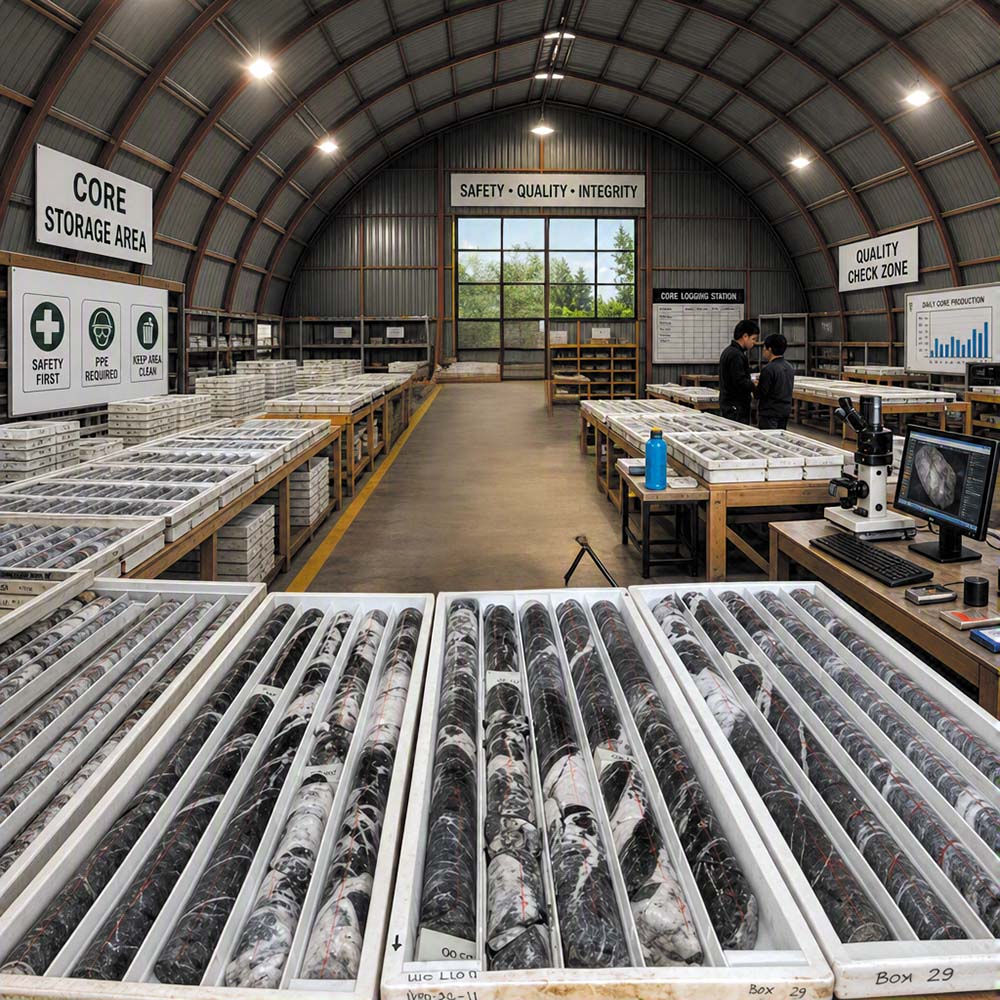
samples inside a gold exploration
facility.
He sees particular potential in areas where modern exploration methods can reveal deposits concealed beneath volcanic material.
“Hishikari is a concealed ore body hidden under the cover of historic volcanic material. This setting presents a new underexplored search space with large-scale discovery potential,” he said.
Japan Gold’s early presence has also contributed to broader cooperation between Canadian and Japanese mining interests.
“The work we have done has helped open a pathway for greater cooperation between Canadian exploration expertise and Japanese industry, government and communities. Canada has deep expertise in modern mineral exploration and project development, while Japan offers exceptional geology and a strong culture of long-term partnership.”
As exploration advances, Proust said relationships built with communities will remain central to the company’s work.
“In Japan, relationships built on trust matter, and trust is earned through communication, consistency, respect and transparency.”