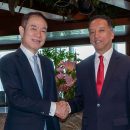

Kazuya Endo, Ambassador of Japan to the Philippines
Bridges: How would you describe the current bilateral relationship between Japan and the Philippines?

Endo: In one phrase, the current state of Philippines-Japan relations can be described as having reached “new heights.” Prime Minister TAKAICHI specifically mentioned the Philippines among all the ASEAN members in her first and second policy speeches to our Diet last October and just this February. High-level meetings, including those at the leaders and ministerial levels, have increased, and our bilateral relations have grown closer across all fields, including politics, the economy, culture, and people-to-people exchanges.
As the top donor of Official Development Assistance (ODA) to the Philippines, Japan has provided critical support in areas such as public transport infrastructure, agriculture, disaster risk reduction, and health. Various forms of cooperation in the maritime domain and in disaster response are also being advanced. In our people-to-people exchange, the number of Filipino visitors to Japan reached a record high of 880,000 in 2025. These developments are evident in daily news coverage.
Why, then, have our relations grown closer? As Antoine de Saint-Exupéry once said, “Love does not consist in gazing at each other, but in looking outward together in the same direction.” I believe this quote aptly captures the defining characteristic of Philippines-Japan relations in recent years. Our relationship is special not only because we value each other or because our partnership serves our respective national interests, but because we share a common purpose of advancing peace and prosperity in the region and the wider international community.
“This year marks the 70th Anniversary of Philippines-Japan friendship, and the Philippines is also serving as ASEAN Chair. Japan and the Philippines will continue to work together not only for the benefit of our two countries, but also for peace and prosperity in the region and the international community as strategic partners sharing the same goal.”
Endo Kazuya, Ambassador of Japan to the Philippines
In recent years, the international environment has become increasingly uncertain and unpredictable, and the regional environment has grown more challenging. In such times, cooperation among countries is essential to maintain and promote peace and prosperity. As we seek to expand such cooperation, partnerships with countries that share fundamental values are of paramount importance.
For Japan, the Philippines is an important neighboring country in working to uphold and strengthen a Free and Open Indo-Pacific and a rules-based international order. In more formal terms, this relationship can be described as a “strategic partnership.” A strategic partnership is not based solely on short-term calculations of gains and losses, but on a relationship in which both countries recognize each other’s long-term importance and necessity.
This year marks the 70th Anniversary of Philippines-Japan friendship, and the Philippines is also serving as ASEAN Chair. Japan and the Philippines will continue to work together not only for the benefit of our two countries, but also for peace and prosperity in the region and the international community as strategic partners sharing the same goal.
How important is it to celebrate the 70th anniversary and what events does the Embassy have planned for 2026?
To mark the 70th Anniversary of Japan-Philippines Friendship, the Embassy of Japan has prepared a wide range of commemorative events and activities throughout 2026. We launched the anniversary year with the Opening Reception and Jazz Performance, “Harmony of Friendship: A Jazz Prelude to 70 Years of Japan–Philippine Ties,” held on January 20.
Jazz, which is deeply appreciated in both cultures, served as a fitting cultural bridge as the collaboration between Japanese and Filipino musicians symbolized the harmony and friendship that underpin our bilateral relationship. In the months ahead, we will continue to host and support cultural, educational, sports, and business-related events, encouraging even more collaboration between our two countries. Information on these anniversary events and activities is available on the Embassy of Japan’s dedicated 70th anniversary webpage.
While these events are important, we see the 70th anniversary as a shared journey rather than a series of one-off celebrations. Throughout this commemorative year, we would like to work together with the Filipino people to reflect on our shared past and envision our future cooperation. We hope to rediscover the “threads” of cooperation woven in the past, while also identifying new “threads” that can shape the next chapter of Philippines-Japan relations. By weaving together these old and new threads, we aspire to build an even more beautiful and resilient tapestry of the friendship between the Philippines and Japan for the future.
“Japan and the Philippines are steadily deepening cooperation based on our shared commitment to the rule of law, freedom of navigation, and a Free and Open Indo-Pacific.”
To commemorate this milestone, we invite our Filipino friends to embark on this shared project together. The Embassy of Japan has opened a call for submissions for commemorative events related to Japan–Philippines exchanges. Approved events can use the official title “Commemorative Event of the Japan–Philippines Friendship Year 2026 (70th Anniversary of the Normalization of Diplomatic Relations)” and the commemorative logo in their promotional materials.
The logo, which combines Japan’s Shimenawa rope with the Filipino abaca (Manila hemp), symbolizes the many “threads” of cooperation that have been woven together over the past seven decades. We warmly invite a wide range of stakeholders to join us in this celebration and to take part in weaving the future of Philippines-Japan relations together.
In terms of politics/security, what steps are Japan and the Philippines taking to strengthen these important areas of cooperation?
Amid an increasingly severe and complex regional security environment, it is imperative that strategic challenges are addressed actively and collectively. Japan and the Philippines are steadily deepening cooperation based on our shared commitment to the rule of law, freedom of navigation, and a Free and Open Indo-Pacific.
While Japan and the Philippines have a long history of cooperation, recent years have seen particularly rapid and steady progress in the security sphere, thanks to the leadership of President Marcos, Jr. Notably, in February, under Japan’s Official Security Assistance (OSA) program, Japan handed over to the Philippine Navy five coastal surveillance radar systems. This support enhances maritime domain awareness and the capacity to monitor activities in surrounding waters.
I am pleased to highlight that our efforts also extend to multilateral cooperation. Together with the United States, the Philippines, and other like-minded countries, Japan has conducted numerous Maritime Cooperative Activities (MCA) including trilateral iteration, which took place in Northern Luzon in February. We also anticipate stronger and more active participation of the Japan Self-Defense Forces in the upcoming Balikatan exercises.
Institutionally, our cooperation has been further strengthened through the Reciprocal Access Agreement, which was formally signed shortly after I began my service in the Philippines, approved in the Senate and Japanese Diet respectively, and implemented. We started the negotiation on the Acquisition and Cross-Servicing Agreement in spring 2025 and officially signed the Agreement during Foreign Minister Motegi’s visit to Manila last January.
As maritime nations situated along vital sea lanes, Japan and the Philippines are natural strategic partners. We will continue to work closely together to uphold a rules-based international order, ensure a free and open maritime domain, and contribute to peace, stability, and prosperity in the Indo-Pacific region.
With both countries aiming to increase engagement and economic cooperation, what can we expect in terms of closer ties in 2026?
As Japan aims to deepen engagement and economic cooperation with the Philippines, the outlook for 2026 appears promising, particularly concerning our economic partnerships. Building on decades of robust collaboration, we anticipate continued progress in our efforts towards shared prosperity and resilience.
Japan’s long-standing commitment to the Philippines is evident in our consistent support through Official Development Assistance (ODA). As the largest ODA provider to the Philippines, our assistance has historically focused on crucial infrastructure projects like the Metro Manila Subway Project (MMSP), the Davao City Bypass Construction Project, and the Pasig-Marikina River Channel Improvement Project.
Beyond these flagship initiatives in transportation and river improvement, Japan’s ODA also extends to a wide array of sectors including agriculture, healthcare, capacity building, and even grassroots initiatives. This broad scope reflects our dedication to addressing diverse developmental needs across the whole country.
Our economic ties also extend significantly to trade and investment. Japan stands as one of the Philippines’ major trading partners and a significant source of foreign direct investment, with a growing number of Japanese companies establishing their presence here. This active business relationship forms a vital pillar of our cooperation.
Looking ahead to 2026, we are keen to expand our cooperation into new and emerging fields. In addition to our ongoing support in traditional sectors, we hope to expand our cooperation into new frontiers, including digital and green transformation, space, and broader economic security.
Our efforts are geared towards fostering the further deepening of our bilateral relations. Through these multifaceted approaches, we believe both our nations can continue to advance towards shared success and prosperity in 2026 and beyond.
People-to-people exchanges reflect the strong bonds between the Philippines and Japan. What is the Embassy doing to contribute in these areas?
People-to-people exchanges form the foundation of our bilateral relations. In my interactions with Filipino friends, I am happy to learn of their deep interest in Japanese culture. Whether I attend locally organized cultural events or host visitors at my residence, topics like Japanese food, anime, and travel are always mentioned, turning conversations into meaningful and enjoyable exchanges.
With this in mind, we aim to further promote exchanges between Japan and the Philippines. Opportunities such as the Japanese Government Scholarship Program (MEXT), the Japan-East Asia Network of Exchange for Students and Youths (JENESYS) Program, and the Japan Exchange and Teaching (JET) Program are excellent avenues in deepening the bonds between our two peoples.
Former MEXT scholarship students to Japan are now active in various fields in the Philippines, contributing to the advancement of Japan-Philippines relations. The JENESYS program shows that students as young as those in high school level can already participate in people-to-people exchanges. Assistant Language Teachers (ALTs) coming to Japan through the JET Program are also contributing to improving the quality of English education in Japan, and fostering a foundation for Japanese people to embrace multiculturalism.
Moreover, I am delighted to note that Japan welcomed more than 880,000 Filipino visitors in 2025 alone. With the official opening of the Japan Visa Application Centre (JVAC) last year, we hope to provide better services to Filipinos applying for a visa by amplifying our efforts to further strengthen the ties of our countries and peoples.