
Mention “space,” and most people picture rockets roaring into the heavens, astronauts floating weightlessly aboard the International Space Station or galaxies too distant to imagine. Rarely do they think of flooded communities receiving faster disaster assessments, communities benefiting from better environmental data, or Filipino students watching their experiments come alive hundreds of kilometers above Earth.
Yet that’s precisely where one of the Philippines’ most meaningful partnerships with Japan is making its mark. As both countries celebrate the 10th anniversary of the launch of the Diwata-1 microsatellite and reaffirm their commitment to deeper cooperation in space, the real story isn’t just about what’s happening in orbit. It’s about the very tangible ways space science is steadily improving life back home.
That partnership reached another milestone in May 2026, when the Philippine Space Agency (PhilSA) and the Japan Aerospace Exploration Agency (JAXA) signed a Joint Declaration of Interest in Space Cooperation during President Ferdinand R. Marcos Jr.’s state visit to Japan. The declaration reaffirms both countries’ shared commitment to expanding collaboration in satellite joint mission partnerships and data applications, space exploration and human spaceflight, and space sustainability.
But beyond the diplomatic milestone lies a far more compelling story, one measured not by satellites launched or agreements signed, but by safer communities, better-informed farmers, inspired young scientists and a partnership that continues to demonstrate that space, at its best, serves life here on Earth.
Space saves lives
Long before rescue teams arrive on the ground, satellites are often among the first responders.
For two decades, Sentinel Asia, an international cooperation initiative led by JAXA and the Asian Disaster Reduction Center (ADRC), has been providing countries across the Asia-Pacific with rapid access to satellite imagery during disasters. Established under the Asia-Pacific Regional Space Agency Forum (APRSAF), the program allows participating nations to request satellite data that can help assess damage and support emergency response when every minute counts.
The Philippines has become one of its active beneficiaries. Between 2024 and 2025 alone, Philippine institutions, including PAGASA, PHIVOLCS, the Mines and Geosciences Bureau (MGB), and PhilSA, made 20 emergency observation requests through Sentinel Asia. Most were related to floods, landslides and storms, while others supported responses to earthquakes, an oil spill and volcanic activity.
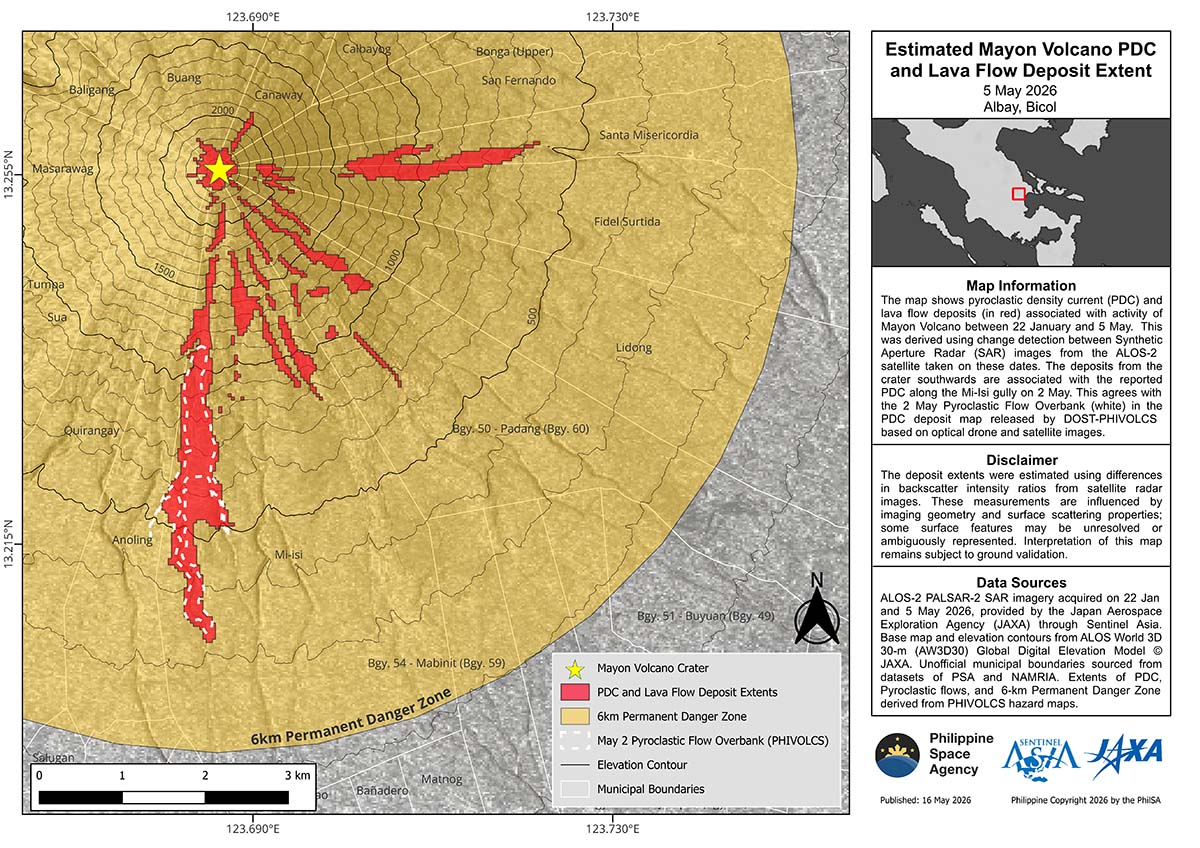
One recent example came in May, following a pyroclastic density current event at Mayon Volcano. Using data from JAXA’s ALOS-2 Synthetic Aperture Radar (SAR) satellite, PhilSA mapped the extent of lava flows and volcanic deposits from volcanic activity that occurred between January and May 2026, including areas obscured by cloud cover or inaccessible to drones and field teams. The result was a clearer picture of rapidly changing conditions, giving scientists and decision-makers critical information when communities faced real danger.
As President Marcos observed during the 31st Asia-Pacific Regional Space Agency Forum (APRSAF-31) in Cebu last year, “Space must serve the people.” It is a simple idea, but one that has increasingly defined how the Philippines approaches its growing space program.
Space grows minds
The partnership between the Philippines and Japan extends much further than disaster resilience. It is also helping cultivate something equally valuable: curiosity.
Through JAXA’s Kibo Asian Beneficial Collaboration (Kibo-ABC), PhilSA has opened doors for Filipino researchers, educators and students to take part in projects connected to the Japanese Experiment Module, known as Kibo, aboard the International Space Station. What once felt like the realm of science fiction has become an opportunity for young Filipinos to contribute to real scientific research.
Since 2022, Philippine teams have participated in the Asian Try Zero-G program, where astronauts aboard the International Space Station perform experiments conceived by students across Asia. Other initiatives, such as the Asian Herb in Space (AHIS) project, have introduced Philippine schools to space-exposed seeds, allowing students to conduct their own research using seeds previously exposed to the space environment.
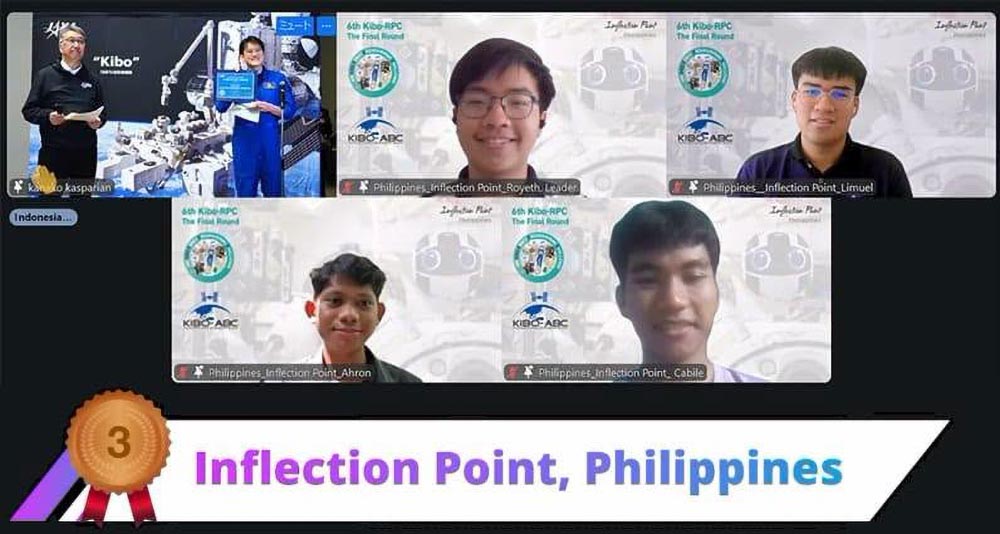
Filipino talent has also earned recognition on the global stage. Earlier this year, Team Inflection Point from Batangas State University placed third in the Kibo Robot Programming Challenge, developing software to control robotic systems aboard the International Space Station. It’s a reminder that the next generation of scientists, engineers and innovators may well be sitting in today’s classrooms, looking skyward while creating solutions for life here on Earth.
The partnership between the Philippines and Japan extends much further than disaster resilience. It is also helping cultivate something equally valuable: curiosity.
Space feeds nations
The next frontier of Philippine-Japan cooperation isn’t only about what lies beyond our atmosphere. Increasingly, it’s about using space technology to address challenges much closer to home.
The Joint Declaration of Interest signed by PhilSA and JAXA outlines plans to deepen collaboration in satellite joint mission partnerships and data applications, alongside space exploration, human spaceflight and space sustainability. Behind the technical language lies a practical ambition: harnessing innovation to improve environmental monitoring, strengthen climate resilience and support food security.
Those priorities were echoed in the Philippines-Japan Joint Statement on the Elevation to a Comprehensive Strategic Partnership, where President Marcos and Japanese Prime Minister Sanae Takaichi affirmed that technological innovation, including cooperation in space and digital transformation, would play a key role in advancing sustainable prosperity and food security.
For an archipelago where livelihoods are deeply intertwined with weather patterns, agriculture and marine resources, satellite data has become far more than an academic exercise. It can help monitor changing landscapes, track environmental conditions and provide information that supports better planning for communities and industries alike.
Space strengthens friendships
Long before the latest agreement was signed, the Philippines and Japan had already been charting this course together.
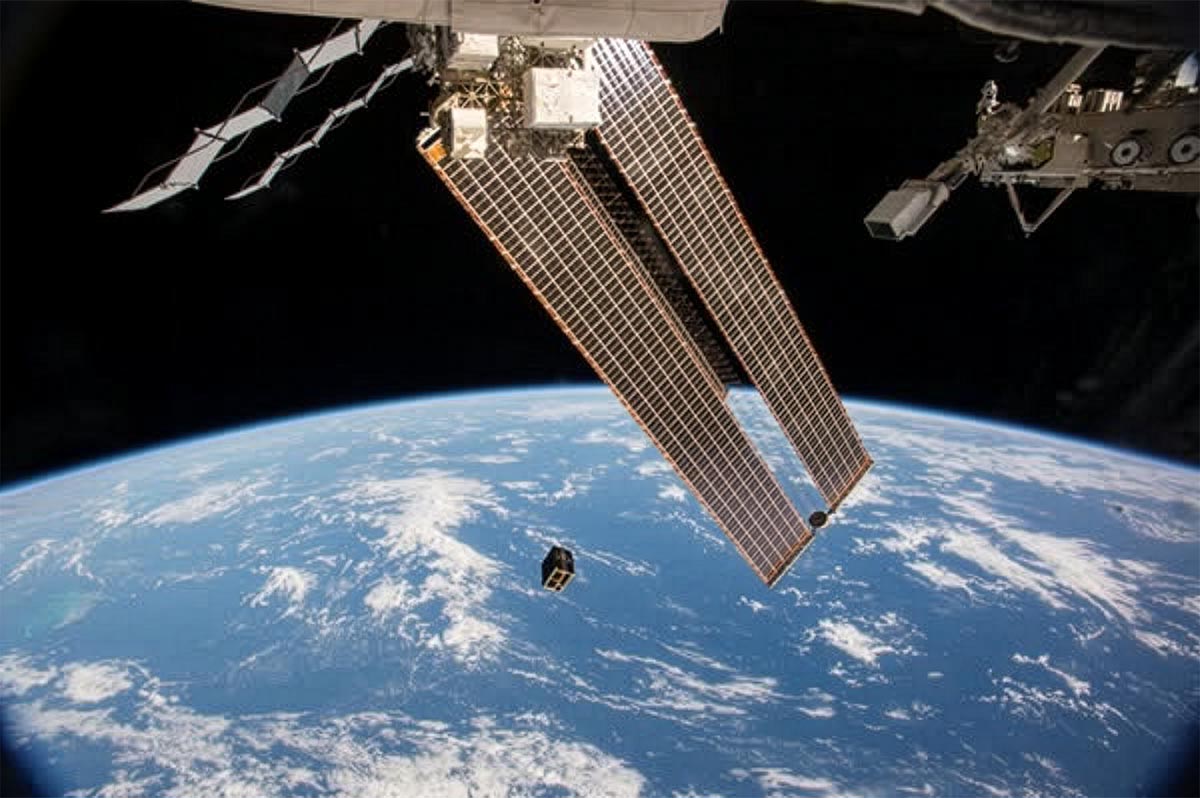
This year marks a decade since Diwata-1 was deployed into orbit from the Japanese Experiment Module aboard the International Space Station in 2016. Developed by Filipino engineers with support from Japanese universities and JAXA, Diwata-1 represented far more than a technological milestone. It signaled the beginning of a new chapter in Philippine space science, one built on collaboration, knowledge sharing and a belief that even emerging space nations have a place in the global conversation.
That spirit of cooperation has continued to flourish. In November 2025, the Philippines and Japan co-hosted the 31st Asia-Pacific Regional Space Agency Forum (APRSAF-31) in Cebu, the region’s largest gathering of space agencies and stakeholders. Bringing together experts from across Asia and the Pacific, the forum underscored a shared conviction that space science is no longer the exclusive domain of a handful of nations. It is increasingly becoming a platform for regional cooperation, innovation and inclusive development.
The partnership between the Philippines and Japan may begin hundreds of kilometers above the Earth, but its impact is measured not in altitude, but in safer communities, brighter young minds and a shared commitment to building a more resilient future.
The recent declaration between PhilSA and JAXA is, in many ways, the natural next step in that journey. It reaffirms a partnership that has steadily evolved over the past decade, from launching a pioneering microsatellite and responding to disasters to nurturing young scientists and exploring new opportunities in space research and sustainability.
It is easy to think of space as something distant, outside the reach and concerns of everyday life. Yet every time satellite data helps nations prepare for disasters, researchers better understand the environment or students see their ideas tested aboard the International Space Station, space feels a little closer to home.
The partnership between the Philippines and Japan may begin hundreds of kilometers above the Earth, but its impact is measured not in altitude, but in safer communities, brighter young minds and a shared commitment to building a more resilient future.