

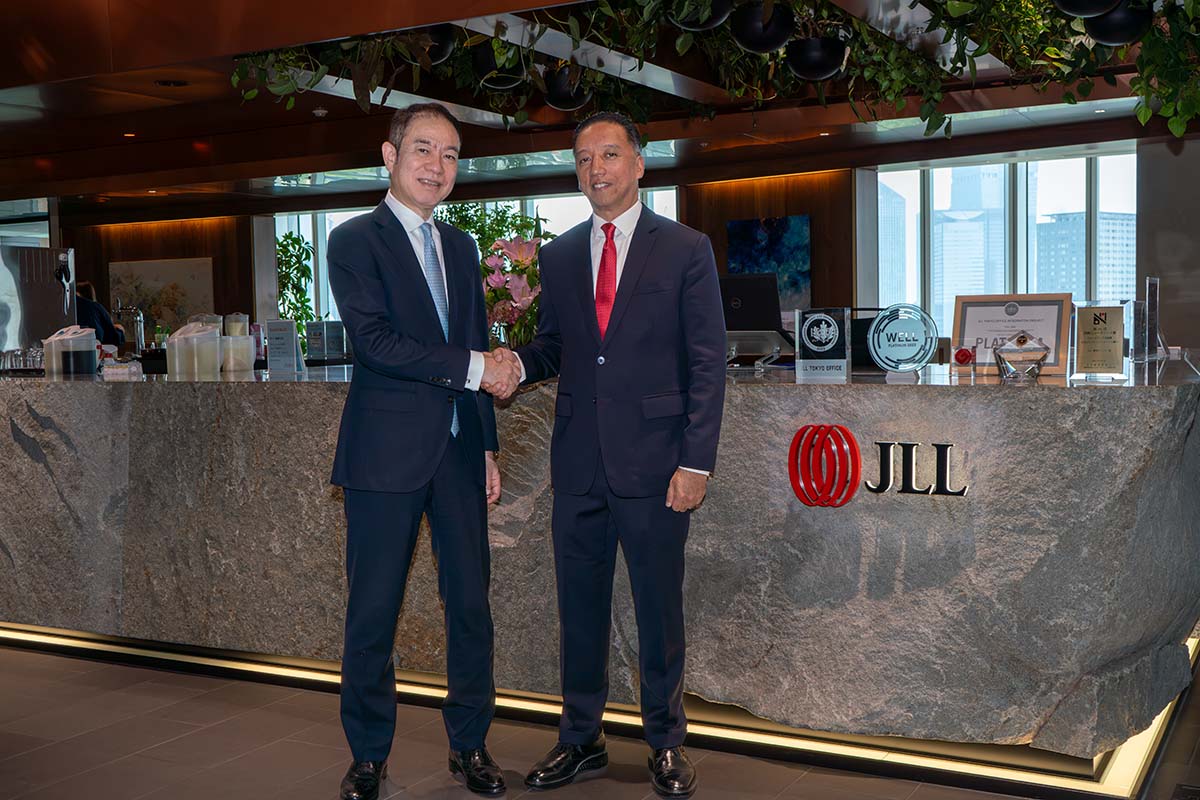
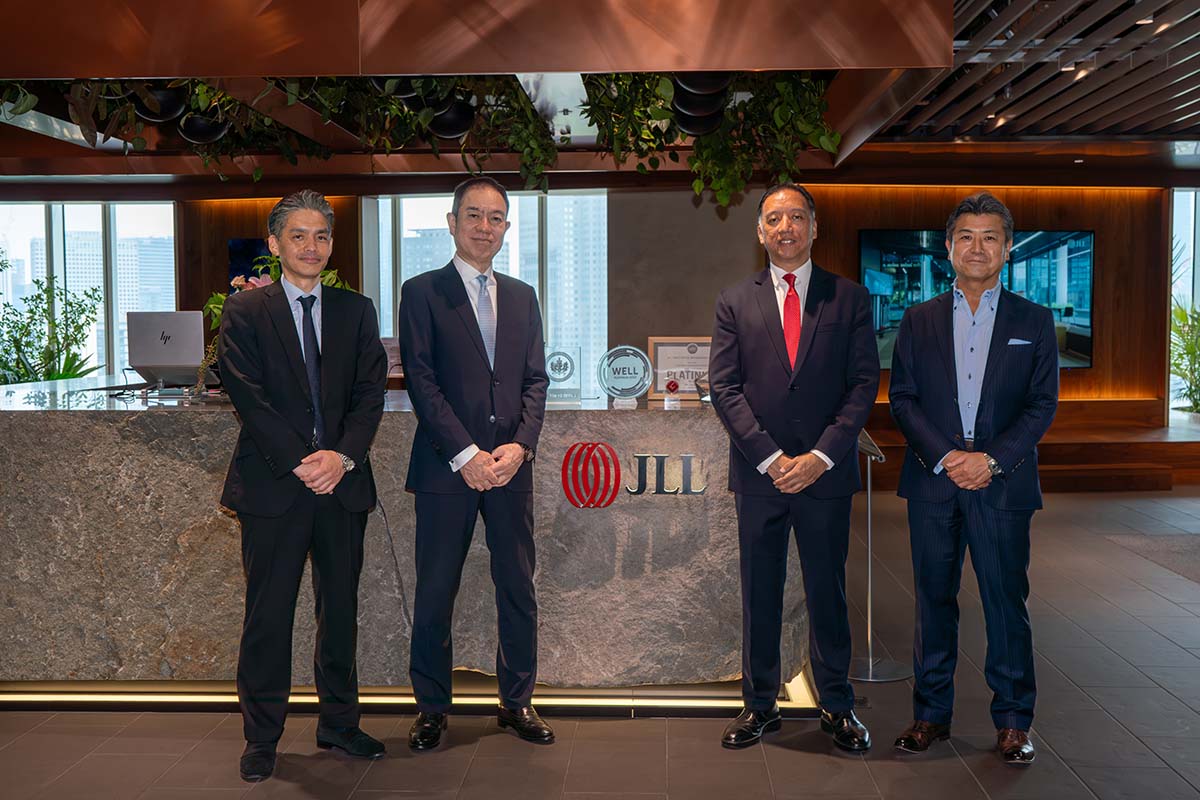
Joey Radovan, Country Head of JLL Philippines, and Toshinobu Kasai, Country Head of JLL Japan, at JLL’s Tokyo office.
Jones Lang LaSalle Incorporated — JLL — is one of the world’s largest publicly listed commercial real estate services and investment management companies, headquartered in Chicago and operating in 80 countries. JLL helps buy, build, occupy, manage and invest in a variety of industries and property types, including office, industrial, hotel, multifamily, retail and data center properties. In the Philippines, that global reach has quietly become one of the most consequential threads in the Japan–Philippines investment story.
In 1997, JLL opened its doors in the Philippines with an office in Makati City. JLL’s current office is located at NEX Tower, a Grade A office building along Ayala Avenue. Next year marks thirty years of that operation — three decades in which the firm has gone from a newcomer in an unfamiliar market to the country’s leading real estate advisory house, supporting professional real estate strategic advisory and transactions in the Philippines from office headquarter relocations, IT and BPO office expansion to industrial leasing and land sales across the archipelago.
It is fitting, then, that as JLL Philippines approaches this milestone, one of its most active growth areas is a renewed collaboration with JLL’s Japan office — a partnership built not on novelty, but on a relationship between our two countries that predates either of our firms.
“Thirty years in, the most meaningful way to mark the milestone is the same way we built it: by being useful to the people and capital moving between our two countries.”
Japan has long been the steadiest hand in Philippine infrastructure. JICA’s decades of official development assistance-built roads, ports, and rail long before “supply chain resilience” became a boardroom phrase. That patience is now translating into real estate demand. During President Marcos’s state visit to Tokyo in May, Japanese corporations committed an aggregate $3.4 billion in fresh investment pledges — capital that, in time, needs offices to fill, warehouses to operate from, and factories to occupy. The Department of Trade and Industry and Japan’s Ministry of Land, Infrastructure, Transport and Tourism have likewise begun building a formal platform for real estate dialogue between the two countries, recognizing that infrastructure cooperation and property investment are now two sides of the same conversation.
This is the gap JLL Philippines and JLL Japan are working together to close. A Japanese manufacturer evaluating a logistics footprint in Central Luzon, or an investor assessing office assets in Bonifacio Global City, should not have to choose between a team that understands Tokyo’s underwriting standards and one that understands Manila’s permitting realities. Increasingly, they should not have to choose at all. Our two offices are aligned on exactly that: joint client coverage, shared market intelligence, and a coordinated point of entry for Japanese capital moving into the Philippines, and, just as importantly, for Filipino enterprises and investors looking toward Japan.
The timing is not incidental. The Philippines is in the middle of its most consequential infrastructure decade in a generation — the Luzon Economic Corridor, the Subic–Clark–Manila–Batangas rail line, and a wave of new economic zones are reshaping where business happens outside Metro Manila. Japan, as the corridor’s founding infrastructure partner since 2024, has a long-standing stake here that predates the headlines. For Japanese investors who have watched the country’s transformation from the ground up through JICA and JETRO, the next logical step is not just funding the roads, but occupying the buildings at the end of them.
Thirty years ago, JLL’s task in the Philippines was to explain what professional real estate advisory even meant in a market still finding its institutional footing. Today, the task is different: connecting two of Asia’s most enduring economic relationships through the unglamorous, indispensable work of corporate real estate — site selection, lease structuring, asset management, and capital deployment.

What makes the story distinctly trilateral is the vantage point from which JLL operates it. A firm born in Chicago, embedded in Manila for three decades, now coordinating capital flows with Tokyo — the geography of that arrangement is not incidental. American advisory standards, Philippine market fluency, and Japanese investment appetite form a triangle that few firms are positioned to work from all three corners simultaneously.
“We don’t think of this as an anniversary to be celebrated quietly. Thirty years in, the most meaningful way to mark the milestone is the same way we built it: by being useful to the people and capital moving between our two countries. The bridge between Tokyo and Manila was never going to be built by one office alone. We intend to keep building it together.”